Explosive containers#5091

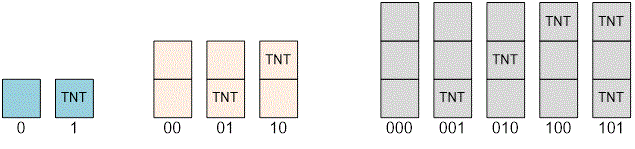
Each empty box is represented by , and each TNT box by . The task is to determine the number of strings of length , consisting of s and s, such that no two s are adjacent.
The answer to the problem will be the Fibonacci number :
Example
Consider all possible towers of heights n = 1, n = 2, n = 3. Each corresponds to a sequence of s and s. There are:
two towers of height : ;
three towers of height : "00", "01", "10";
five towers of height : "000", "001", "010", "100", "101";
Algorithm implementation
Declare an array.
#define MAX 45
int fib[MAX];
Fill the elements of the array with Fibonacci numbers according to the recurrence formula.
fib[1] = 2; fib[2] = 3;
for (int i = 3; i < MAX; i++)
  fib[i] = fib[i - 1] + fib[i - 2];
Read the input value of and print the answer.
scanf("%d", &n);
printf("%d\n", fib[n]);
Algorithm implementation – memoization
Declare an array.
#define MAX 45
int fib[MAX];
The function f computes the -th Fibonacci number.
int f(int n)
{
  if (n == 1) return 2;
  if (n == 2) return 3;
  if (fib[n] != -1) return fib[n];
  return fib[n] = f(n - 1) + f(n - 2);
}The main part of the program. Read the input value of and print the result.
scanf("%d", &n);
memset(fib, -1, sizeof(fib));
printf("%d\n", f(n));
Java implementation
import java.util.*;

public class Main
{
  static int fib[] = new int[45];

  static int f(int n)
  {
    if (n == 1) return 2;
    if (n == 2) return 3;
    if (fib[n] != -1) return fib[n];
    return fib[n] = f(n-1) + f(n - 2);
  }

  public static void main(String[] args)
  {
    Scanner con = new Scanner(System.in);
    int n = con.nextInt();
    Arrays.fill(fib, -1);
    System.out.println(f(n));
    con.close();
  }
}Python implementation — list
Fill the elements of the list with Fibonacci numbers according to the recurrence formula.
lst = [0, 2, 3]
for i in range(3, 45):
  lst.append(lst[i - 2] + lst[i - 1])
Read the input value of and print the result.
n = int(input())
print(lst[n])
Python implementation — memoization
The function fib computes the -th Fibonacci number.
def fib(n):
  if dp[n] != -1:
    return dp[n]
  dp[n] = fib(n - 1) + fib(n - 2)
  return dp[n]
The main part of the program. Read the input value of .
n = int(input())The list will store Fibonacci numbers. Initialize its initial values.
dp = (n + 2) * [-1]
dp[1] = 2
dp[2] = 3
Compute and print the answer.
print(fib(n))