Stars#5619

Astronomers often examine star maps, where stars are represented as points on a plane, each having Cartesian coordinates. Define the level of a star as the number of stars that are not higher and not to the right of the given star. Astronomers are interested in the distribution of the levels of the stars.
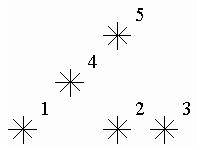
For example, consider the map shown above. The level of star number 5 is 3 (formed by stars numbered 1, 2, and 4). The levels of stars 2 and 4 are 1. On this map, there is only one star of level 0, two stars of level 1, one star of level 2, and one star of level 3.
You are to write a program that counts the number of stars for each level on the given map.
The first line contains the number of stars (1 \leq n \leq 15000). The following lines describe the coordinates of the stars: two integers and per line, separated by a space, where 0 \leq x, y \leq 32000. There is at most one star at any point. The stars are listed in ascending order of coordinate. Stars with equal coordinates are given in ascending order of coordinate.
Print lines. The -th line should contain the number of stars of level i-1 (the first line corresponds to level , the second to level , and so on, with the last line for level n-1).
1-nji mysal