Minimum Sum#6198

Consider the case of arrays with two elements. Let A = \{p, q\}~(p < q) and B = \{x, y\}. Let's examine the condition under which the sum p \cdot x + q \cdot y will be minimized. Let's consider two permutation options:
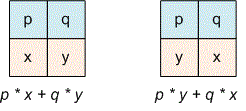
The inequality p \cdot x + q \cdot y < p \cdot y + q \cdot x holds if
Given that p \ne q, dividing the inequality by (p - q) < 0, we obtain x > y. This means that the sum p \cdot x + q \cdot y (when p < q) will be minimized if x > y.
Consider a pair of elements from the original arrays and . If a_i < a_j and b_i < b_j, then by swapping b_i and b_j, we decrease the total sum.
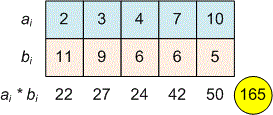
Sort array in ascending order and array in descending order. Then we'll obtain the sum with the smallest value
Example
Compute the sum for the given example.
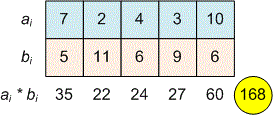
Let's take a pair where a_1 < a_5 and b_1 < b_5. Swapping b_1 and b_5 will decrease the sum.
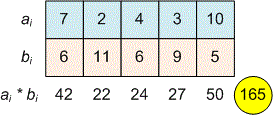
For the given example, for any pair , if a_i < a_j, then b_i > b_j. Therefore, the current permutation is optimal.
Let’s consider obtaining the minimum sum by sorting array in ascending order and array in descending order.
Algorithm realization
Declare the input arrays.
#define MAX 101
int a[MAX], b[MAX];
Read the input data.
scanf("%d",&n);
for(i = 0; i < n; i++)
  scanf("%d",&a[i]);
for(i = 0; i < n; i++)
  scanf("%d",&b[i]);
Sort the first array in ascending order, and the second array in descending order.
sort(a,a+n);
sort(b,b+n,greater<int>());
Compute the desired minimum sum, which can be a -bit integer.
res = 0;
for(i = 0; i < n; i++)
  res += 1LL * a[i] * b[i];
Print the answer.
printf("%lld\n",res);Java realization
import java.util.*;

public class Main
{
  public static void main(String[] args)
  {
    Scanner con = new Scanner(System.in);
    int n = con.nextInt();
    Integer a[] = new Integer[n];
    for(int i = 0; i < n; i++)
      a[i] = con.nextInt();

    Integer b[] = new Integer[n];
    for(int i = 0; i < n; i++)
      b[i] = con.nextInt();

    Arrays.sort(a);
    Arrays.sort(b,Collections.reverseOrder());

    long res = 0;
    for(int i = 0; i < n; i++)
      res += 1L * a[i] * b[i];

    System.out.println(res);
    con.close();
  }
} Python realization
Read the input data.
n = int(input())
l1 = list(map(int,input().split()))
l2 = list(map(int,input().split()))
Sort the first array in ascending order, and the second array in descending order.
l1.sort()
l2.sort(reverse = True)
Compute the desired minimum sum.
res = 0
for i in range(n):
  res += l1[i] * l2[i]
Print the answer.
print(res)