Dwarf Tower#6263

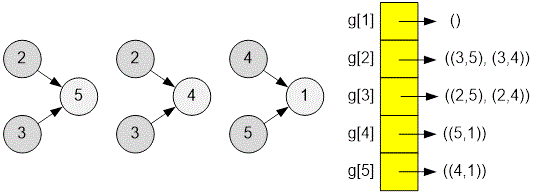
Build a graph in the form of an adjacency list , where contains pairs of numbers such that items and can be combined to produce item : (i, j) \to a.
Let be an array initially containing the purchase costs of the items (cost[i] = c_i). By the end of the algorithm will store the minimum amount of money required to obtain item .
Initially, all items are considered unprocessed (used[i] = 0).
While there is at least one unprocessed item:
Find the item with the smallest cost;
Apply all rules listed in ;
Mark item as processed: used[a] = 0;
For each rule (a, b) \to to from we recompute
Example
Consider the first test. There are items with the following purchase costs:

There are three item crafting rules. Let's build an adjacency list based on them.
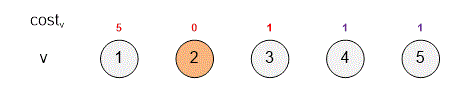
Item has the smallest cost: cost[2] = 0. Apply all rules involving item , namely those listed in . After that, mark item as processed.
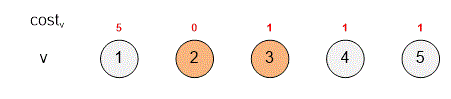
The next unprocessed item with the smallest cost is . Apply the rules listed in . The costs of the items do not change in this step.
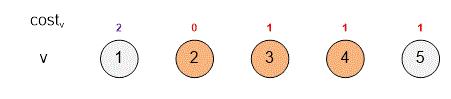
Next, the unprocessed item with the smallest cost becomes item . Apply the rule from .
In the subsequent operations, the costs of the items do not change. Thus, the minimum cost to obtain item is .
Algorithm implementation
Declare the arrays. Declare an adjacency list , which will contain the item crafting rules.
vector<int> cost, used;
vector<vector<pair<int, int>>> g;
Read the input data. Initialize the arrays.
scanf("%d %d", &n, &m);
g.resize(n + 1);
cost.resize(n + 1);
used.resize(n + 1);
Read the purchase costs of the items.
for (i = 1; i <= n; i++)
  scanf("%d", &cost[i]);
Read the item crafting rules and build an adjacency list based on them.
for (i = 0; i < m; i++)
{
  scanf("%d %d %d", &a, &x, &y);
  g[x].push_back(make_pair(y, a));
  g[y].push_back(make_pair(x, a));
}
Perform iterations.
for (k = 0; k < n; k++)
{
In each iteration, among the unprocessed items, find the one with the smallest cost. Let this be the item with number .
  mn = 2e9; a = -1;
  for (i = 1; i <= n; i++)
    if (!used[i] && cost[i] < mn)
    {
      mn = cost[i];
      a = i;
}Mark item as processed.
used[a] = 1;Iterate through all rules involving item .
      for (auto x : g[a])
      {
         b = x.first;
         to = x.second; // (a, b) -> to
         if (cost[a] + cost[b] < cost[to]) cost[to] = cost[a] + cost[b];
  }
}Print the minimum amount of money required to purchase the first item.
printf("%d\n", cost[1]);Python implementation
In Python, is a special value representing infinity. It is available in the module, which must be imported to use it.
from math import infRead the input data.
n, m = map(int, input().split())
cost = [0] + list(map(int, input().split()))
Initialize the lists.
used = [False] * (n + 1)
g = [[] for _ in range(n + 1)]
Read the item crafting rules and build an adjacency list based on them.
for _ in range(m):
  a, x, y = map(int, input().split())
  g[x].append((y, a))
  g[y].append((x, a))
Perform iterations.
for k in range(n):In each iteration, among the unprocessed items, find the one with the smallest cost. Let this be the item with number .
  mn = inf
  a = -1
  for i in range(1, n + 1):
    if not used[i] and cost[i] < mn:
      mn = cost[i]
      a = i
Mark item as processed.
used[a] = TrueIterate through all rules involving item .
  for b, to in g[a]:
    if cost[a] + cost[b] < cost[to]:
       cost[to] = cost[a] + cost[b]
Print the minimum amount of money required to purchase the first item.
print(cost[1])