Roads#776

Since the graph contains vertices, we'll use an adjacency list to store it. Based on the input list of edges, build the corresponding representation of the graph. Then, using depth-first search, determine the number of connected components. The number of new roads that need to be built is equal to the number of connected components minus one.
Example
The graph shown in the example has the following structure:
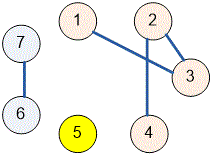
The graph consists of three connected components. To merge them into one, it is enough to add two edges.
Algorithm implementation
Declare an adjacency list and an array to mark the visited vertices.
vector<vector<int> > g;
vector<int> used;
The function dfs performs a depth-first search starting from vertex .
void dfs(int v)
{
  used[v] = 1;
  for (int to : g[v])
    if (!used[to]) dfs(to);
}
The main part of the program. Read the input data.
scanf("%d %d", &n, &m);
g.resize(n + 1);
Read edges and build the adjacency list of the graph.
for (i = 1; i <= m; i++)
{
  scanf("%d %d", &a, &b);
  g[a].push_back(b);
  g[b].push_back(a);
}
Perform a depth-first search on the disconnected graph. The variable is used to count the number of connected components.
used.resize(n + 1);
cnt = 0;
for (i = 1; i <= n; i++)
  if (used[i] == 0)
  {
    dfs(i);
    cnt++;
}Print the number of roads that need to be built.
printf("%d\n", cnt - 1);Algorithm implementation — disjoint sets
#include <stdio.h>
#define MAX 10001

int mas[MAX];

int Repr(int n)
{
  while (n != mas[n]) n = mas[n];
  return n;
}

void Union(int x, int y)
{
  int x1 = Repr(x), y1 = Repr(y);
  if (x1 == y1) return;
  mas[x1] = y1;
}

int a, b, i, j, n, m, count;

int main(void)
{
  scanf("%d %d", &n, &m);
  for (i = 1; i <= n; i++) mas[i] = i;
  for (i = 0; i < m; i++)
  {
    scanf("%d %d", &a, &b);
    Union(a, b);
  }

  count = 0;
  for (i = 1; i <= n; i++)
    if (mas[i] == i) count++;
  printf("%d\n", count - 1);
  return 0;
}Java implementation
import java.util.*;

public class Main
{
  static ArrayList<Integer>[] g;
  static boolean used[];
  static int n, m;

  static void dfs(int v)
  {
    used[v] = true;
    for(int i = 0; i < g[v].size(); i++)
    {
      int to = g[v].get(i);
      if (used[to] == false) dfs(to);
    }
  }

  @SuppressWarnings("unchecked")
  public static void main(String[] args)
  {
    Scanner con = new Scanner(System.in);
    n = con.nextInt();
    m = con.nextInt();

    used = new boolean[n+1];
    g = new ArrayList[n+1];
    for(int i = 0; i <= n; i++)
      g[i] = new ArrayList<Integer>();

    for (int i = 0; i < m; i++)
    {
      int a = con.nextInt();
      int b = con.nextInt();
      g[a].add(b);
      g[b].add(a);
    }

    int cnt = 0;
    for(int i = 1; i <= n; i++)
      if (used[i] == false)
      {
        dfs(i);
        cnt++;
      }

    System.out.println(cnt - 1);
    con.close();
  }
} Python implementation
Increase the recursion stack size.
import sys
sys.setrecursionlimit(1000000)
The function dfs performs a depth-first search starting from vertex .
def dfs(v):
  used[v] = 1
  for to in g[v]:
    if not used[to]:
      dfs(to)
The main part of the program. Read the input data.
n, m = map(int, input().split())
g = [[] for _ in range(n + 1)]
used = [0] * (n + 1)
Read edges and build the adjacency list of the graph.
for _ in range(m):
  a, b = map(int, input().split())
  g[a].append(b)
  g[b].append(a)
Perform a depth-first search on the disconnected graph. The variable is used to count the number of connected components.
cnt = 0
for i in range(1, n + 1):
  if not used[i]:
    dfs(i)
    cnt += 1
Print the number of roads that need to be built.
print(cnt - 1)