Book shelf#8355

The shelf where the books are placed is represented as a double-ended queue. The task requires simulating the following operations:
push_front — place a book with the number on the left;
push_back — place a book with the number on the right;
pop_front() — remove a book from the left edge;
pop_back() — remove a book from the right edge;
Example
Let's consider the sequence of book placements on the shelf.
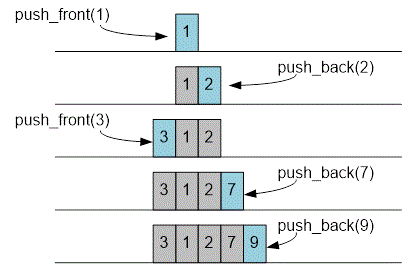
The books are removed from the shelf in the following order:
pop\_front() — book number ;
pop\_back() — book number ;
pop\_front() — book number ;
pop\_front() — book number ;
pop\_back() — book number ;
Algorithm implementation
Declare a double ended queue.
deque<int> s;Read the number of operations .
scanf("%d",&n);Process the operations sequentially.
for(i = 0; i < n; i++)
{
Read the operation code .
  scanf("%d",&cmd);
  if (cmd == 1)
  {
Place the book with the number on the left edge of the shelf.
    scanf("%d",&val);
    s.push_front(val);
  } else
  if (cmd == 2)
  {
Place the book with the number on the right edge of the shelf.
    scanf("%d",&val);
    s.push_back(val);
  } else
  if (cmd == 3)
  {
Print the number of the book from the left edge and remove it.
    printf("%d\n",s.front());
    s.pop_front();
  } else
  {
Print the number of the book from the right edge and remove it.
    printf("%d\n",s.back());
    s.pop_back();
  }
}
Java implementation — LinkedList
import java.util.*;

public class Main
{
  public static void main(String[] args)
  {
    Scanner con = new Scanner(System.in);
    Deque<Integer> q = new LinkedList<Integer>();
    int n = con.nextInt();
    for (int i = 0; i < n; i++)
    {
      int cmd = con.nextInt();
      if (cmd == 1)
      {
        int val = con.nextInt();
        q.addFirst(val);
      } else
      if (cmd == 2)
      {
        int val = con.nextInt();
        q.addLast(val);
      } else
      if (cmd == 3)
      {
        System.out.println(q.getFirst());
        q.removeFirst();
      } else
      {
        System.out.println(q.getLast());
        q.removeLast();
      }
    }
    con.close();
 }
} Python implementation
Declare a double ended queue .
from collections import deque
q = deque()
Read the number of operations .
n = int(input())Process the operations sequentially.
for i in range(n):
  op, *lst = list(map(int, input().split()))

  if op == 1:
Place the book with the number on the left edge of the shelf.
    q.appendleft(lst[0])
  elif op == 2:
Place the book with the number on the right edge of the shelf.
    q.append(lst[0])
  elif op == 3:
Print the number of the book from the left edge and remove it.
    print(q.popleft())
  else:
Print the number of the book from the right edge and remove it.
print(q.pop())