Journey from west to east#8596

There are cities located on a straight line from west to east. The cities are numbered from to in order from west to east. Each point on the line has a one-dimensional coordinate, where a point farther to the east has a larger coordinate. The coordinate of the -th city is x_i.
You are currently in city and want to visit all cities (each at least once), moving in any order. You have two ways to travel:
Walk along the straight line. For every unit distance you move (in any direction), your fatigue increases by units.
Teleport to any location you choose. Your fatigue increases by units, regardless of the teleported distance.
Your goal is to visit all cities, possibly choosing the travel mode for each move, such that the total fatigue is minimized.
The first line contains three integers , , and (2 \leq n \leq 10^5; 1 \leq a, b \leq 10^9).
The second line contains integers x_1, x_2, \ldots, x_n (1 \leq x_i \leq 10^9).
It is guaranteed that for all (1 \leq i \leq n-1), x_i < x_{i+1}.
Print the minimum possible fatigue level needed to visit all cities.
Example 1
Example 2
Example 3
Test 1.
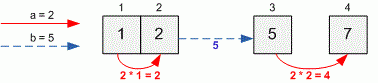
From city , walk to city , then teleport to city . Then walk to city . The total fatigue will be 2 \cdot 1 + 5 + 2 \cdot 2 = 11, which is minimal.
Test 3.
Visit all cities (in any order) by teleporting six times. The total fatigue will be , which is minimal.