Train Swapping#8735

Let the array contain the input permutation — the current order of the train cars. The desired minimum number of swaps is equal to the number of inversions in this permutation.
An inversion is a pair of elements (m_i, m_j) such that i < j but m_i > m_j. In other words, a pair of elements forms an inversion if they are arranged in the wrong order.
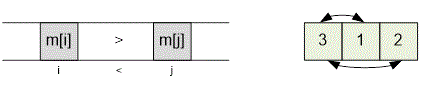
For example, in the array m = \{3, 1, 2\}, the pairs and form inversions. The pair does not form an inversion since the numbers and are in the correct relative order.
The number of inversions in an array of length can be counted using a double loop: iterate over all possible pairs such that 1 \le i < j \le n, and if m_i > m_j, increase the inversion counter by one.
Example
Let us consider an example of counting inversions in a permutation. Under each number, we'll write the number of inversions it forms with the elements to its right. Let denote the number of indices such that i < j and m[i] > m[j].
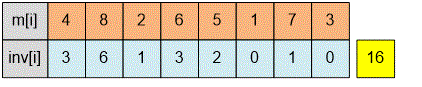
The total number of inversions is .
Exercise
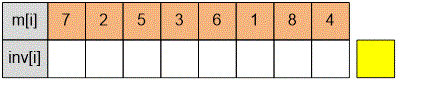
Simulate the solution for the following example.
Algorithm implementation
Declare the array .
int m[100010];Sequentially process all test cases.
scanf("%d", &tests);
while (tests--)
{
Read the input order of the train cars into the array .
  scanf("%d", &n);
  for (i = 0; i < n; i++)
    scanf("%d", &m[i]);
The minimum number of swaps required to arrange the train in order is computed and stored in the variable .
  res = 0;
  for (i = 0; i < n - 1; i++)
  for (j = i + 1; j < n; j++)
    if (m[i] > m[j]) res++;
Print the answer.
  printf("Optimal train swapping takes %lld swaps.\n", res);
}