Depth First Search#8760

Let's build an adjacency matrix from the list of edges. Start a depth-first search from the specified vertex . Each time we enter a new vertex, we print its number.
Exercise
Solve the problem for the next graphs:
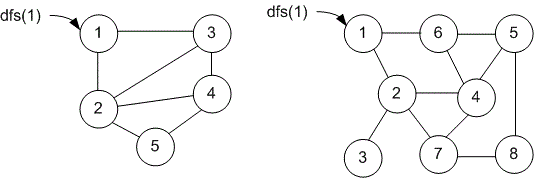
Algorithm realization — adjacency matrix
Declare an adjacency matrix and an array .
#define MAX 101
int g[MAX][MAX], used[MAX];
The dfs function performs a depth-first search from vertex .
void dfs(int v)
{
Print the vertex .
printf("%d ", v);Mark the vertex as visited.
used[v] = 1;Iterate over the vertices , that can be reached from . Moving from to is possible if:
There is an edge , that is, g[v][i] = 1;
The vertex is not visited (used[i] = 0)
If both conditions are true, we continue the depth-first search from vertex .
  for (int i = 1; i <= n; i++)
    if ((g[v][i] == 1) && (used[i] == 0)) dfs(i);
}
The main part of the program. Read the number of vertices and edges in the graph.
scanf("%d %d", &n, &m);}Initialize the arrays with zeroes.
memset(g, 0, sizeof(g));
memset(used, 0, sizeof(used));
Read the list of edges. Construct the adjacency matrix.
for (i = 0; i < m; i++)
{
  scanf("%d %d", &a, &b);
  g[a][b] = g[b][a] = 1;
}
Read vertex and start a depth-first search from it.
scanf("%d", &v);
dfs(v);
printf("\n");
Algorithm realization — adjacency list
Declare an adjacency list and an array .
vector<vector<int> > g;
vector<int> used;
The dfs function performs a depth-first search from vertex .
void dfs(int v)
{
Mark the vertex as visited.
used[v] = 1;Print the vertex .
printf("%d ", v);The array contains a list of vertices adjacent to . Iterate over the vertices that can be reached from .
for (int to : g[v])Consider the edge (v, to). We can move to vertex from if the vertex is not visited (used[to] = 0).
    if (used[to] == 0) dfs(to);
}
The main part of the program. Read the number of vertices and edges in the graph.
scanf("%d %d", &n, &m);Set the size of arrays and .
g.resize(n + 1);
used.resize(n + 1);
Read the list of edges. Construct the adjacency list.
for (int i = 0; i < m; i++)
{
  scanf("%d %d", &a, &b);
  g[a].push_back(b);
  g[b].push_back(a);
}
Read vertex and start a depth-first search from it.
scanf("%d", &v);
dfs(v);
printf("\n");
Java realization — adjacency matrix
import java.util.*;

public class Main
{
  static int g[][], used[];
  static int n, m;

  static void dfs(int v)
  {
    System.out.printf(v + " ");
    used[v] = 1;
    for(int i = 1; i <= n; i++)
      if (g[v][i] == 1 && used[i] == 0) dfs(i);
  }

  public static void main(String[] args)
  {
    Scanner con = new Scanner(System.in);
    n = con.nextInt();
    m = con.nextInt();
    g = new int[n+1][n+1];
    used = new int[n+1];

    for (int i = 0; i < m; i++)
    {
      int a = con.nextInt();
      int b = con.nextInt();
      g[a][b] = g[b][a] = 1;
    }

    int v = con.nextInt();
    dfs(v);
    System.out.println();
  }
}
Java realization — array of ArrayList
import java.util.*;

public class Main
{
  static ArrayList<Integer>[] g;
  static int used[];
  static int n, m;

  static void dfs(int v)
  {
    System.out.print(v + " ");
    used[v] = 1;
    for(int to : g[v])
      if (used[to] == 0) dfs(to);
  }

  public static void main(String[] args)
  {
    Scanner con = new Scanner(System.in);
    n = con.nextInt();
    m = con.nextInt();
    g = new ArrayList[n+1]; // unchecked
    used = new int[n+1];

    for (int i = 1; i <= n; i++)
      g[i] = new ArrayList<Integer>();

    for (int i = 0; i < m; i++)
    {
      int a = con.nextInt();
      int b = con.nextInt();
      g[a].add(b);
      g[b].add(a);
    }

    int v = con.nextInt();
    dfs(v);
    System.out.println();

    con.close();
  }
}
Java realization — ArrayList of ArrayList
import java.util.*;

public class Main
{
  static ArrayList<ArrayList<Integer>> g;
  static int used[];
  static int n, m;

  static void dfs(int v)
  {
    System.out.printf(v + " ");
    used[v] = 1;
    for(int i = 0; i < g.get(v).size(); i++)
    {
      int to = g.get(v).get(i);
      if (used[to] == 0) dfs(to);
    }
  }

  public static void main(String[] args)
  {
    Scanner con = new Scanner(System.in);
    n = con.nextInt();
    m = con.nextInt();
    g = new ArrayList<ArrayList<Integer>>();
    used = new int[n+1];

    for (int i = 0; i <= n; i++)
      g.add(new ArrayList<Integer>());

    for (int i = 0; i < m; i++)
    {
      int a = con.nextInt();
      int b = con.nextInt();
      g.get(a).add(b);
      g.get(b).add(a);
    }

    int v = con.nextInt();
    dfs(v);
    System.out.println();

    con.close();
  }
} Python realization
The dfs function performs a depth-first search from vertex .
def dfs(v):Print the vertex .
print(v, end = ' ')Mark the vertex as visited.
used[v] = TrueThe list contains the numbers of vertices adjacent to . Iterate over the vertices that can be reached from . It's possible to go to vertex from if vertex is not visited (used[to] = 0).
  for to in g[v]:
    if not used[to]: dfs(to)
The main part of the program. Read the number of vertices and edges in the graph.
n, m = map(int, input().split())Create the adjacency list and the list .
g = [[] for _ in range(n+1)]
used = [False] * (n + 1)
Read the list of edges. Construct the adjacency list.
for _ in range(m):
  a, b = map(int, input().split())
  g[a].append(b)
  g[b].append(a)
Read vertex and start a depth-first search from it.
v = int(input())
dfs(v)