Count the triplets#9022

Let's sort all three arrays. For each element b_j, use binary search to determine:
the number of elements in array that are less than b_j,
the number of elements in array that are greater than b_j.
Then, for a fixed value of b_j, there are exactly x * y triplets of the form (a_i, b_j, c_k) that satisfy the inequality a_i < b_j < c_k.
Example
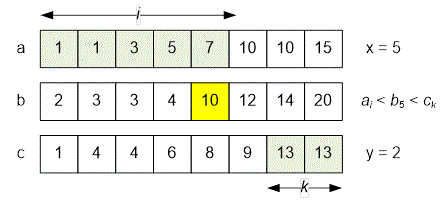
Let's consider the sorted arrays and compute the number of valid triplets for b_5 = 10.
We have: a_i < b_5 for i \le 5, and c_k > b_5 for k \ge 7.
Thus, the inequality a_i < b_5 < c_k holds for 1 \le i \le 5 and 7 \le k \le 8.
The number of triplets (a_i, b_5, c_k) is 5 * 2 = 10.
Algorithm implementation
Declare the arrays.
#define MAX 100000
int a[MAX], b[MAX], c[MAX];
Read the input data.
scanf("%d", &n);
for (i = 0; i < n; i++) scanf("%d", &a[i]);
for (i = 0; i < n; i++) scanf("%d", &b[i]);
for (i = 0; i < n; i++) scanf("%d", &c[i]);
Sort the arrays.
sort(a, a + n);
sort(b, b + n);
sort(c, c + n);
Count the number of valid triplets using the variable . Iterate over the values of b_j.
res = 0;
for (j = 0; j < n; j++)
{
The number of elements in array that are less than b_j is .
x = lower_bound(a, a + n, b[j]) - a;The number of elements in array that are greater than b_j is .
y = n - (upper_bound(c, c + n, b[j]) - c);Then, for the given value of b_j, there are exactly x * y valid triplets.
  res += x * y;
}
Print the answer.
printf("%lld\n", res);Java implementation
import java.util.*;

public class Main
{
  static int lower_bound(int m[], int start, int end, int x)
  {
    while (start < end)
    {
      int mid = (start + end) / 2;
      if (x <= m[mid])
         end = mid;
      else
        start = mid + 1;
    }
    return start;
  }

  static int upper_bound(int m[], int start, int end, int x)
  {
    while (start < end)
    {
      int mid = (start + end) / 2;
      if (x >= m[mid])
        start = mid + 1;
      else
        end = mid;
    }
    return start;
  }

  public static void main(String[] args)
  {
    Scanner con = new Scanner(System.in);
    int i, n = con.nextInt();
    int a[] = new int[n];
    for(i = 0; i < n; i++) a[i] = con.nextInt();

    int b[] = new int[n];
    for(i = 0; i < n; i++) b[i] = con.nextInt();

    int c[] = new int[n];
    for(i = 0; i < n; i++) c[i] = con.nextInt();

    Arrays.sort(a); Arrays.sort(b); Arrays.sort(c);

    long res = 0;
    for (i = 0; i < n; i++)
    {
      int x = lower_bound(a, 0, n, b[i]);
      int y = n - (upper_bound(c, 0, n, b[i]));
      res += 1L * x * y;
    }

    System.out.println(res);
    con.close();
  }
}