Roads renewal#9032

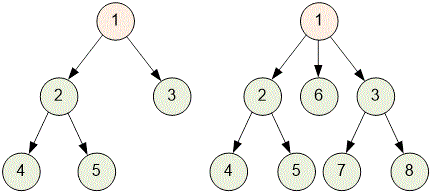
Consider an undirected graph and identify its connected components. If a connected component is a tree (that is, it contains no cycles), its edges can always be oriented so that exactly one vertex has no incoming edges. This means that in a tree component, the minimum possible number of isolated cities after the reform is (zero is impossible). For example, the root of the tree can be chosen as the isolated city.
If a connected component contains a cycle, its edges can always be oriented so that every vertex has at least one incoming edge.
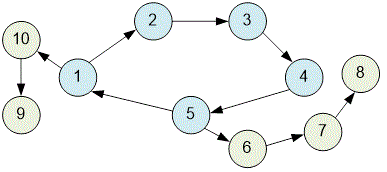
The answer to the problem is the number of connected components that do not contain cycles.
Example
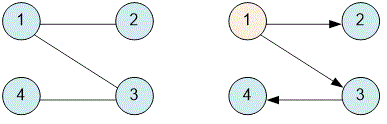
Consider the first example. The graph on the left is the initial one, and the graph on the right is the graph after the reform. Vertex has no incoming edges.
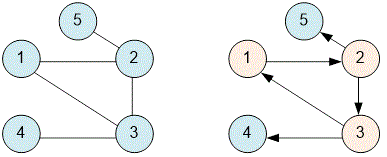
Let's consider the second example. On the left is the original graph, and on the right is the graph after the reform. Each vertex has exactly one incoming edge.
Algorithm implementation
Declare an adjacency list to store the structure of the graph, as well as an array to mark already visited vertices.
vector<vector<int> > g;
vector<int> used;
The function dfs performs a depth-first search starting from vertex . The parent of vertex is vertex .
void dfs(int v, int p = -1)
{
  used[v] = 1;
  for (int to : g[v])
  {
    if (to == p) continue;
If a cycle is detected in the current connected component, set flag = 0.
    if (used[to] == 1) flag = 0;
    else dfs(to, v);
  }
}
The main part of the program. Read the input data.
scanf("%d %d", &n, &m);
g.resize(n + 1);
used.resize(n + 1);
Read edges and construct the graph.
for (i = 0; i < m; i++)
{
  scanf("%d %d", &a, &b);
  g[a].push_back(b);
  g[b].push_back(a);
}
Perform depth-first search on a disconnected graph. The variable stores the number of connected components that contain no cycles.
res = 0;
for (i = 1; i <= n; i++)
{
  if (used[i] == 0)
  {
Before processing each component, set flag = 1. If a cycle is detected during the traversal, then after the dfs call completes, the value of will become .
    flag = 1;
    dfs(i);
    res += flag;
  }
}
Print the answer.
printf("%d\n", res);