Interesting Product#916

Declare a data structure map<int, int> m to count how many times the product i \cdot j occurs. The number of unique products is equal to the size of the map .
Example
Let's consider the second example. Let's write the multiplication table for the matrix [2; 4] \times [2; 5].
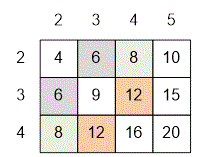
The table contains unique values.
Algorithm implementation
Declare a structure for storing data.
map<int, int> m;Read the input data.
scanf("%d %d %d %d",&a,&b,&c,&d);Swap and , as well as and , to ensure the conditions a \le b, c \le d are satisfied.
if (a > b) swap(a,b);
if (c > d) swap(c,d);
Iterate through all possible products i \cdot j. For each product, increment by the value associated with the key i \cdot j in the map.
for(i = a; i <= b; i++)
for(j = c; j <= d; j++)
  m[i*j]++;
Print the result — the size of the map .
printf("%d\n",m.size());Java implementation
import java.util.*;

public class Main
{
  public static void main(String[] args)
  {
Scanner con = new Scanner(System.in);Read the input data.
    int a = con.nextInt();
    int b = con.nextInt();
    int c = con.nextInt();
    int d = con.nextInt();
Swap and , as well as and , to ensure the conditions a \le b, c \le d are satisfied.
    if (a > b) {int temp = a; a = b; b = temp;}
    if (c > d) {int temp = c; c = d; d = temp;}
Declare a structure for storing data.
Map<Integer,Integer> m = new HashMap<Integer,Integer>();Iterate through all possible products i \cdot j.
    for(int i = a; i <= b; i++)
    for(int j = c; j <= d; j++)
    {
      int key = i * j;
Increment by the value associated with the key i \cdot j. If no value is associated with the key yet, default it to .
      m.put(key, m.getOrDefault(key, 0) + 1);
    }
Print the result — the size of the map .
    System.out.println(m.size());
    con.close();
  }
}
Python implementation
Read the input data.
a, b, c, d = map(int, input().split())Declare a dictionary for storing data.
m = {}Swap and , as well as and , to ensure the conditions a \le b, c \le d are satisfied.
if a > b:
  a, b = b, a
if c > d:
  c, d = d, c
Iterate through all possible products i \cdot j. For each product, increment by the value associated with the key i \cdot j in the dictionary.
for i in range(a, b+1):
  for j in range(c, d+1):
    key = i * j
    m[key] = m.get(key, 0) + 1
Print the result — the size of the dictionary .
print(len(m))