Concatenation of two palindromes#9592

Let us represent a string of length as the concatenation of two non-empty palindromes of lengths and n - l.
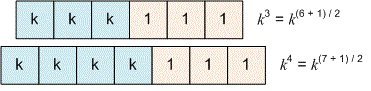
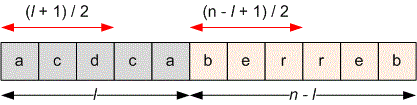
Consider a palindrome of length . Since a palindrome reads the same from left to right and from right to left, its second half is completely determined by its first half. Therefore, it is sufficient to choose arbitrarily only the first (l + 1) / 2 characters, each of which can be any of the letters of the alphabet. The remaining characters are then uniquely determined so that the string forms a palindrome.
Thus, the total number of palindromes of length is k^{(l+1)/2}.
Similarly, for a palindrome of length n - l, its second half is completely determined by its first half. Therefore, the first (n - l + 1) / 2 characters can be chosen arbitrarily, with each of them selected from the letters of the alphabet, while the remaining characters are uniquely determined by the palindrome property.
Consequently, the number of palindromes of length n - l is k^{(n-l+1)/2}.
Constructing the concatenation of two palindromes with lengths and n - l can be done in
ways. Since neither of the palindromes should be empty, then 1 \le l \le n - 1. The total number of possible palindromes is
All operations should be carried out modulo 10^9 + 7.
Example
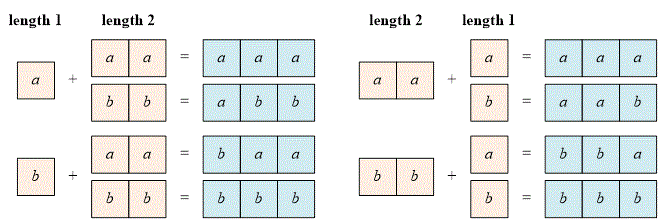
Consider the second example, in which the length of the string is and the alphabet consists of two letters. Let these letters be and .
Palindromes of length : and .
Palindromes of length : and .
Thus, there are exactly desired strings of length :
Algorithm implementation
The computations are performed modulo 10^9 + 7. Let's define the modulo .
#define MOD 1000000007The powmod function computes the value of x^n~mod~m.
long long powmod(long long x, long long n, long long m)
{
  if (n == 0) return 1;
  if (n % 2 == 0) return powmod((x * x) % m, n / 2, m);
  return (x * powmod(x, n - 1, m)) % m;
}
The main part of the program. Read the input data.
scanf("%d %d", &n, &k);Compute the answer using the formula.
res = 0;
for (l = 1; l < n; l++)
  res = (res + powmod(k, (l + 1) / 2, MOD) *
               powmod(k, (n - l + 1) / 2, MOD)) % MOD;
Print the answer.
printf("%lld\n", res);Java implementation
import java.util.*;

public class Main
{
  public final static long MOD = 1000000007;

  static long PowMod(long x, long n, long m)
  {
    if (n == 0) return 1;
    if (n % 2 == 0) return PowMod((x * x) % m, n / 2, m);
    return (x * PowMod(x, n - 1, m)) % m;
  }

  public static void main(String[] args)
  {
    Scanner con = new Scanner(System.in);
    long n = con.nextLong();
    long k = con.nextLong();
    long res = 0;
    for (long l = 1; l < n; l++)
      res = (res + PowMod(k, (l + 1) / 2, MOD) *
                   PowMod(k, (n - l + 1) / 2, MOD)) % MOD;
    System.out.println(res);
    con.close();
  }
}Python implementation
The computations are performed modulo 10^9 + 7. Let's define the modulo .
mod = 10 ** 9 + 7Read the input data.
n, k = map(int, input().split())Compute the answer using the formula.
res = 0;
for l in range(1,n):
  res = (res + pow(k, (l + 1) // 2, mod) *
               pow(k, (n - l + 1) // 2, mod)) % mod;
Print the answer.
print(res)