Photoshoot#9597

The number a_1 can range from to . Given a fixed value of a_1, the remaining numbers in the sequence a_2, ..., a_n are uniquely determined. Iterate a_1 from to , restore the sequence and verify whether it constitutes a permutation of numbers from to (all a_i must be distinct and fall within the range from to ). Once the reconstructed sequence forms a permutation, print it and terminate the program.
Since b_i = a_i + a_{i+1}, then a_{i+1} = b_i - a_i or a_i = b_{i-1} - a_{i-1}.
Example
Let a_1 = 3. Then sequence b = (4, 6, 7, 6) generates the following sequence :
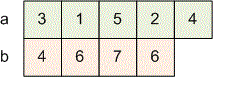
The sequence a = (3, 1, 5, 2, 4) is a permutation. The following relationship holds: 3 + 1 = 4, 1 + 5 = 6, 5 + 2 = 7 and 2 + 4 = 6.
If, for example, we choose a_1 = 1, then the following sequence will be restored from the input sequence b = (4, 6, 7, 6):
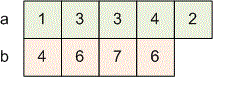
The sequence a = (1, 3, 3, 4, 2) is not a permutation.
Algorithm implementation
Declare the arrays. The array will be used to verify whether is a permutation.
#define MAX 1001
int a[MAX], b[MAX], used[MAX];
Read the input data.
scanf("%d", &n);
for (i = 0; i < n - 1; i++)
  scanf("%d", &b[i]);
Iterate over the value of a_0 from to .
for (a0 = 1; a0 <= n; a0++)
{
  a[0] = a0;
Compute the elements of the sequence using the formula a_i = b_{i-1} - a_{i-1}.
  for (i = 1; i < n; i++)
    a[i] = b[i - 1] - a[i - 1];
Initialize the array with zeroes.
for (i = 1; i <= n; i++) used[i] = 0;Check if is a permutation. Each value of a_i must appear in the sequence only once and be within the range from to . The variable will be set to if the sequence is not a permutation.
  flag = 0;
  for (i = 0; i < n; i++)
  {
    if (a[i] < 1 || a[i] > n || used[a[i]])
    {
      flag = 1;
      break;
    }
    used[a[i]] = 1;
}If the sequence is a permutation, print it and terminate the program.
  if (flag == 0)
  {
    for (i = 0; i < n; i++)
      printf("%d ", a[i]);
    printf("\n");
    return 0;
  }
}Python implementation
Read the input data.
n = int(input())
b = list(map(int, input().split()))
Declare the lists. The list will be used to check if is a permutation.
a = [0] * n
used = [0] * (n + 1)
Iterate over the value of a_0 from to .
for a0 in range(1, n + 1):
  a[0] = a0
Compute the elements of the sequence using the formula a_i = b_{i-1} - a_{i-1}.
  for i in range(1, n):
    a[i] = b[i - 1] - a[i - 1]
Initialize the list with zeroes.
  for i in range(1, n + 1):
    used[i] = 0
Check if is a permutation. Each value of a_i must appear in the sequence only once and be within the range from to . The variable will be set to if the sequence is not a permutation.
  flag = 0
  for i in range(n):
    if a[i] < 1 or a[i] > n or used[a[i]]:
      flag = 1
      break
    used[a[i]] = 1
If the sequence is a permutation, print it and terminate the program.
  if flag == 0:
    print(*a)
    break