Anti-palindromic strings#9616

If a string does not contain palindromic substrings of length or , then it does not contain palindromic substrings of length greater than one at all.
If n = 1, then a string of length can consist of any of the letters. In this case, the number of valid strings is .
If m = 1 and n > 1, then the answer is , since there is only one possible string of the form , and it contains the palindrome .
If n = 2, then the first position of the string can contain any of the letters, and the second position can contain any of the remaining m - 1 letters. The letters in the first and second positions must be different; otherwise, they would form a palindrome of length . Therefore, the number of valid strings is
Let the length of the string be greater than . The first position can contain any of the letters, and the second position can contain any of the remaining m - 1 letters. The letter in the third position must be different from the letter in the second position to avoid forming a palindrome of length , and also different from the letter in the first position so that the first three characters do not form a palindrome of length . Therefore, the third position can contain any of the m - 2 letters.
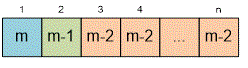
Following this logic, we conclude that the letter at the -th position must be different from the letters at positions i - 1 and i - 2. Thus, for each position starting from the third, there are exactly m - 2 valid choices for the letter.
Therefore, the number of valid strings is
Algorithm implementation
Define the modulus under which all computations will be performed.
#define MOD 1000000007The function powmod computes the value of x^n~mod~m.
long long powmod(long long x, long long n, long long m)
{
  if (n == 0) return 1;
  if (n % 2 == 0) return powmod((x * x) % m, n / 2, m);
  return (x * powmod(x, n - 1, m)) % m;
}
The main part of the program. Read the input data.
scanf("%d", &tests);
while (tests--)
{
  scanf("%lld %lld", &n, &m);
Compute the answer depending on the values of and .
  if (n == 1) res = m; else
  if (m == 1) res = 0; else // n > 1, m = 1:  aa....a
  if (n == 2) res = (m * (m - 1)) % MOD; else
  res = ((m * (m - 1)) % MOD * powmod(m - 2, n - 2, MOD)) % MOD;
Print the answer.
  printf("%lld\n", res);
}