Frog#9628

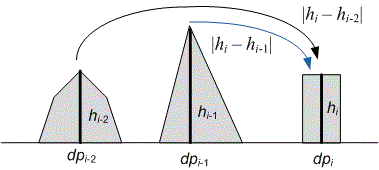
Let be the minimum cost of moving the frog to stone . Then:
dp[1] = 0 (no need to move anywhere),
dp[2] = | h_2 - h_1 |;
The frog can jump to the i~(i \ge 3)-th stone:
either from the (i - 1)-th stone with a cost of |h_i - h_{i-1}|;
or from the (i - 2)-th stone with a cost of |h_i - h_{i-2}|;
Hence
Example
For the given example, the frog’s path with a cost of 20 + 10 = 30 looks like:
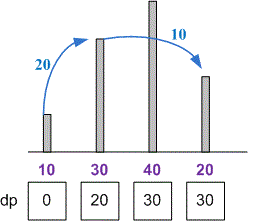
dp[1] = 0;
dp[2] = | h_2 - h_1 | = | 30 - 10 | = 20;
dp[3] = min( dp[2] + |h_3 - h_2| , dp[1] + |h_3 - h_1| ) = \\ min( 20 + | 40 - 30 | , 0 + | 40 - 10 | ) = min(30, 30) = 30;
dp[4] = min( dp[3] + |h_4 - h_3| , dp[2] + |h_4 - h_2| ) = \\ min( 30 + | 20 - 40 | , 20 + | 20 - 30 | ) = min(50, 30) = 30;
Exercise
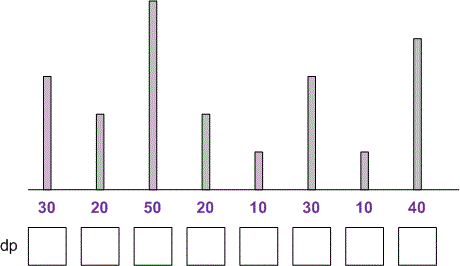
Fill the array for the following example:
Algorithm implementation
Declare the arrays.
#define MAX 100001
int h[MAX], dp[MAX];
Read the input data. Store the heights of the stones in the array .
scanf("%d", &n);
for (i = 1; i <= n; i++)
  scanf("%d", &h[i]);
Initialize the values of and .
dp[1] = 0;
dp[2] = abs(h[2] - h[1]);
Compute the values of dp[i]~(3 \le i \le n).
for (i = 3; i <= n; i++)
{
  a = dp[i - 1] + abs(h[i] - h[i - 1]);
  b = dp[i - 2] + abs(h[i] - h[i - 2]);
  dp[i] = min(a, b);
}
Print the answer.
printf("%d\n", dp[n]);Java implementation
import java.util.*;

class Main
{
  static int h[], dp[];

  public static void main(String[] args)
  {
    Scanner con = new Scanner(System.in);
    int n = con.nextInt();
    h = new int[n+1];
    dp = new int[n+1];
    for(int i = 1; i <= n; i++)
      h[i] = con.nextInt();

    dp[1] = 0;  dp[2] = Math.abs(h[2] - h[1]);
    for (int i = 3; i <= n; i++)
    {
      int a = dp[i - 1] + Math.abs(h[i] - h[i - 1]);
      int b = dp[i - 2] + Math.abs(h[i] - h[i - 2]);
      dp[i] = Math.min(a, b);
    }

    System.out.println(dp[n]);
    con.close();
  }
}Python implementation
Read the input data. Store the heights of the stones in the list .
n = int(input())
h = list(map(int, input().split()))
Initialize the list and assign values to and .
dp = [0] * (n + 1)
dp[1] = 0
dp[2] = abs(h[1] - h[0])
Compute the values of dp[i]~(3 \le i \le n).
for i in range(3, n + 1):
  a = dp[i - 1] + abs(h[i - 1] - h[i - 2])
  b = dp[i - 2] + abs(h[i - 1] - h[i - 3])
  dp[i] = min(a, b)
Print the answer.
print(dp[n])