Transport system#9635

Let's run a breadth-first search starting from the source vertex and the destination vertex . Store the shortest distances from in the array and from in the array .
Let optDistance denote the shortest distance between and in the original graph.
Now, let's consider the possibility of building a new road between vertices and .
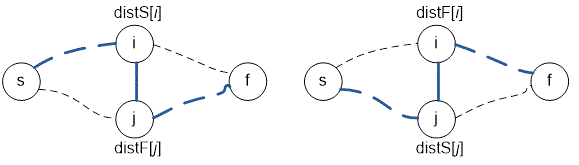
When adding a road to the graph, new paths are created:
If at least one of these distances is smaller than optDistance, then adding the road will decrease the shortest distance between and , and thus it is not suitable.
We now need to check all possible pairs and verify if adding a new road will decrease the shortest distance between and .
Example
The graph from the first test is shown on the left. The shortest distance from vertex to vertex is . No matter which new road we add, this distance will decrease. Therefore, none of the required roads exist.
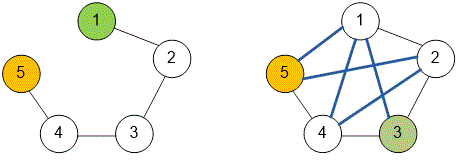
The graph from the second test is shown on the right. The shortest distance from vertex to vertex is . The possible new roads are marked with bold lines. Regardless of which of these roads we build, the distance between and will not decrease.
Algorithm implementation
Define the constant — the maximum possible number of vertices in the graph.
#define MAX 1001Declare the adjacency matrix and the arrays for the shortest distances.
int g[MAX][MAX], distS[MAX], distF[MAX];The function bfs performs a breadth-first search from the vertex . It takes the array as input, where the shortest distances will be stored.
void bfs(int start, int *dist)
{
Initialize the array of shortest distances .
  for (int i = 0; i <= n; i++) dist[i] = -1;
  dist[start] = 0;
Declare a queue and add the starting vertex to it.
  queue<int> q;
  q.push(start);
While the queue is not empty, dequeue the vertex .
  while (!q.empty())
  {

    int v = q.front(); q.pop();
Iterate through all vertices adjacent to . If vertex is not visited yet, compute the shortest distance dist[to] and add it to the queue.
    for (int to = 1; to <= n; to++)
      if (g[v][to] && dist[to] == -1)
      {
        q.push(to);
        dist[to] = dist[v] + 1;
      }
  }
}The main part of the program. Read the input data.
scanf("%d %d %d %d", &n, &m, &s, &f);
memset(g, 0, sizeof(g));
Read the undirected graph.
for (i = 0; i < m; i++)
{
  scanf("%d %d", &a, &b);
  g[a][b] = g[b][a] = 1;
}
Run a breadth-first search from vertices and . The shortest distances are stored in the arrays and , respectively.
bfs(s, distS);
bfs(f, distF);
Let optDistance denote the shortest distance between and in the original graph.
optDistance = distS[f];Iterate through all pairs of vertices and and consider the possibility of building a new road between them. The variable keeps track of the number of such valid roads.
res = 0;
for (i = 1; i <= n; i++)
for (j = i + 1; j <= n; j++)
If there is no road between vertices and , compute the lengths of the shortest paths: s → i → j → f and s → j → i → f. If both of these distances are not less than optDistance, then building such a road is allowed.
  if (g[i][j] == 0)
  {
     if ((distS[i] + distF[j] + 1 >= optDistance) &&
         (distS[j] + distF[i] + 1 >= optDistance))
       res++;
  }
Print the answer.
printf("%d\n", res);Java implementation
import java.util.*;

public class Main
{
  static int g[][], distS[], distF[];
  static int n, m, s, f;

  static void bfs(int start, int dist[])
  {
    Arrays.fill(dist,-1);
    dist[start] = 0;

    Queue<Integer> q = new LinkedList<Integer>();
    q.add(start);

    while(!q.isEmpty())
    {
      int v = q.poll();
      for (int to = 1; to <= n; to++)
        if (g[v][to] == 1 && dist[to] == -1)
        {
          q.add(to);
          dist[to] = dist[v] + 1;
        }
    }
  }

  public static void main(String[] args)
  {
    Scanner con = new Scanner(System.in);
    n = con.nextInt();
    m = con.nextInt();
    s = con.nextInt();
    f = con.nextInt();

    g = new int[n+1][n+1];
    distS = new int[n+1];
    distF = new int[n+1];

    for (int i = 1; i <= m; i++)
    {
      int a = con.nextInt();
      int b = con.nextInt();
      g[a][b] = g[b][a] = 1;
    }

    bfs(s, distS);
    bfs(f, distF);

    int optDistance = distS[f];

    int res = 0;
    for(int i = 1; i <= n; i++)
    for (int j = i + 1; j <= n; j++)
      if (g[i][j] == 0)
      {
        if ((distS[i] + distF[j] + 1 >= optDistance) &&
            (distS[j] + distF[i] + 1 >= optDistance))
          res++;
      }

    System.out.println(res);
    con.close();
  }
}