Floyd - 1#974

The problem requires finding the shortest distances between all pairs of vertices. This is a classical problem solved by the Floyd — Warshall algorithm. The algorithm is based on dynamic programming and works correctly with negative edge weights, provided that the graph contains no negative-weight cycles. This condition is guaranteed in the problem.
Idea of the algorithm. Number the vertices from to . Denote by d_k[i][j] the length of the shortest path from vertex to vertex all of whose intermediate vertices belong to the set \{1, 2, \ldots, k\}. For k = 0 there are no intermediate vertices, so d_0[i][j] equals the weight of the edge i \to j, that is, it coincides with the adjacency matrix.
Consider the shortest path from to whose intermediate vertices lie among \{1, \ldots, k\}. Two cases are possible:
the path does not pass through vertex . Then its length equals d_{k-1}[i][j];
the path passes through vertex . Since there are no negative-weight cycles, it is optimal to visit vertex exactly once. The path splits into two parts: from to and from to . The intermediate vertices of both parts lie among \{1, \ldots, k - 1\}, so the length of the path equals d_{k-1}[i][k] + d_{k-1}[k][j].
Choosing the better of the two options, we obtain the recurrence:
The matrix d_n contains the required shortest distances, since any vertex of the graph may be intermediate in it.
Computing in a single matrix. There is no need to store all the matrices d_0, d_1, \ldots, d_n: all computations can be performed directly in the adjacency matrix . Indeed, at step the values g[i][k] and g[k][j] do not change, since g[k][k] = 0. For example, g[i][k] = \min(g[i][k], g[i][k] + g[k][k]) = g[i][k]. Therefore, it does not matter whether the other elements of the matrix have already been updated at the current step.
It is important that the loop over the intermediate vertex is the outer one: by the time vertex is processed, all distances with intermediate vertices from \{1, \ldots, k - 1\} must already be computed.
Complexity. The algorithm consists of three nested loops of iterations each, so its running time is O(n^3). For n \le 100 this is about 10^6 operations.
Example
The graph given in the example is shown below. The graph is complete, but the edges of weight are not shown in the figure: as we will see below, none of them belongs to any shortest path.
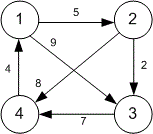
Let us simulate the algorithm. The initial matrix coincides with the adjacency matrix:
\boldsymbol{k = 1}. Paths from vertex become shorter via vertex : g[4][2] = g[4][1] + g[1][2] = 4 + 5 = 9 and g[4][3] = g[4][1] + g[1][3] = 4 + 9 = 13.
\boldsymbol{k = 2}. Via vertex , the following paths become shorter: g[1][3] = g[1][2] + g[2][3] = 5 + 2 = 7, g[1][4] = g[1][2] + g[2][4] = 5 + 8 = 13 and g[4][3] = g[4][2] + g[2][3] = 9 + 2 = 11.
\boldsymbol{k = 3}. Passing through vertex does not shorten any path. For example, g[1][3] + g[3][4] = 7 + 7 = 14 > g[1][4] = 13.
\boldsymbol{k = 4}. Via vertex , paths to vertices and become shorter: g[2][1] = g[2][4] + g[4][1] = 8 + 4 = 12, g[3][1] = g[3][4] + g[4][1] = 7 + 4 = 11 and g[3][2] = g[3][4] + g[4][2] = 7 + 9 = 16.
Note the last update. The value g[4][2] = 9 was obtained at step k = 1 and corresponds to the path 4 \to 1 \to 2. Therefore, g[3][2] = 16 corresponds to the path 3 \to 4 \to 1 \to 2, which has two intermediate vertices.
The final shortest distance matrix coincides with the answer from the example:
Algorithm implementation
Store the adjacency matrix of the graph in the array .
#define MAX 101
int g[MAX][MAX];
The floyd function implements the Floyd — Warshall algorithm.
void floyd(void)
{
  int i, j, k;
  for(k = 0; k < n; k++)
  for(i = 0; i < n; i++)
  for(j = 0; j < n; j++)
    if (g[i][k] + g[k][j] < g[i][j]) g[i][j] = g[i][k] + g[k][j];
}The main part of the program. Read the input graph.
scanf("%d",&n);
for(i = 0; i <  n; i++)
for(j = 0; j <  n; j++)
  scanf("%d",&g[i][j]);
Run the Floyd — Warshall algorithm.
floyd();Print the matrix of the shortest distances between all pairs of vertices.
for(i = 0; i <  n; i++)
{
  for(j = 0; j <  n; j++)
    printf("%d ",g[i][j]);
  printf("\n");
}
Java implementation
import java.util.*;

public class Main
{
  static int g[][];
  static int n;

  static void floyd()
  {
    for(int k = 0; k < n; k++)
    for(int i = 0; i < n; i++)
    for(int j = 0; j < n; j++)
      if (g[i][k] + g[k][j] < g[i][j])
        g[i][j] = g[i][k] + g[k][j];
  }

  public static void main(String[] args)
  {
    Scanner con = new Scanner(System.in);
    n = con.nextInt();
    g = new int[n][n];

    for(int i = 0; i < n; i++)
    for(int j = 0; j < n; j++)
      g[i][j] = con.nextInt();

    floyd();

    for (int i = 0; i < n; i++)
    {
      for (int j = 0; j < n; j++)
    	  System.out.print(g[i][j] + " ");
      System.out.println();
    }
    con.close();
  }
}Python implementation
The floyd function implements the Floyd — Warshall algorithm.
def floyd():
  for k in range(n):
    for i in range(n):
      for j in range(n):
        if g[i][k] + g[k][j] < g[i][j]:
           g[i][j] = g[i][k] + g[k][j]
The main part of the program. Read the input graph.
n = int(input())
g = [[] for _ in range(n)]
for i in range(n):
  g[i] = list(map(int, input().split()))
Run the Floyd — Warshall algorithm.
floyd()Print the matrix of the shortest distances between all pairs of vertices.
for i in range(n):
  print(*g[i])