Justified Jungle#9744

As you probably know, a tree is a graph consisting of nodes and n - 1 undirected edges in which any two nodes are connected by exactly one path. A forest is a graph consisting of one or more trees. In other words, a graph is a forest if every connected component is a tree. A forest is justified if all connected components have the same number of nodes.
Given a tree consisting of nodes, find all positive integers such that a justified forest can be obtained by erasing exactly edges from . Note that erasing an edge never erases any nodes. In particular when we erase all n - 1 edges from , we obtain a justified forest consisting of one-node components.
The first line contains an integer n~(2 \le n \le 10^6) — the number of nodes in . The -th of the following n - 1 lines contains two different integers a_k and b_k~(1 \le a_k, b_k \le n) — the endpoints of the -th edge.
Print in one line all wanted integers , in increasing order.
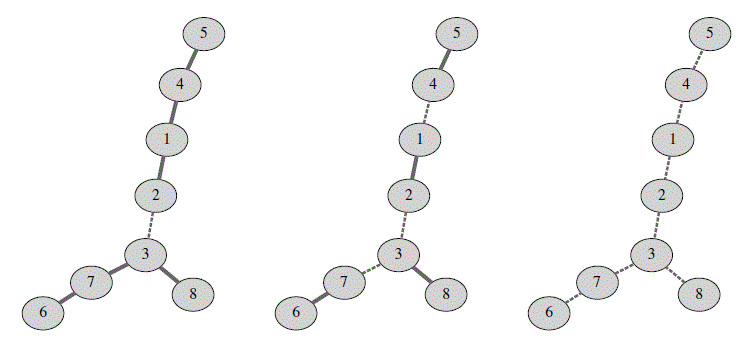
Figures depict justified forests obtained by erasing and edges from the tree in the example input.
Example 1