Be Geeks!#9760

The number of pairs equals n \cdot (n + 1) / 2, and for n = 2 \cdot 10^5 it is about 2 \cdot 10^{10}, so enumerating all segments is impossible. We compute the sum using the "divide and conquer" method, splitting the array at the position of the maximum element.
Splitting at the maximum. Suppose we need to find the sum of P(i, j) over all segments lying inside the segment . Find the position of the maximum element on . Every segment [i; j] \subseteq [b; e] belongs to exactly one of three types:
it contains position , that is, b \le i \le m \le j \le e;
it lies entirely in [b; m - 1];
it lies entirely in [m + 1; e].
Segments of the second and third types are processed recursively. For segments of the first type the maximum equals a_m, so M(i, j) = a_m, and their total contribution equals
It remains to compute quickly the sum of GCDs over all segments containing position .
Decomposing the GCD. A segment containing consists of the left part and the right part . Therefore
Thus, the GCD of a segment is determined by a pair of values: the GCD of the left part and the GCD of the right part.
Groups of endpoints. As increases, the value G(m, j) does not increase. Moreover, whenever it changes, the new value is a proper divisor of the previous one and is therefore at least two times smaller. Hence G(m, j) takes at most \lfloor \log_2 C \rfloor + 1 distinct values, where is the largest element value. For C \le 10^9 this is at most \lfloor \log_2 C \rfloor + 1 = 30 values.
Positions with the same value of G(m, j) form a contiguous block. We call such a block of positions a group. Each group is described by a pair (g, \mathit{cnt}), where is the GCD value and is the number of positions in the group. Similarly, the left endpoints are split into groups by the value of .
The end of a group is found by binary search. If a group starts at position and g = G(m, j), then the equality G(m, t) = g holds for all from to the end of the group and fails for all after it.
Sum over pairs of groups. Let the left group be (g_L, \mathit{cnt}_L), and the right group be (g_R, \mathit{cnt}_R). Then all \mathit{cnt}_L \cdot \mathit{cnt}_R segments whose left endpoint lies in the left group and whose right endpoint lies in the right group have the same GCD \gcd(g_L, g_R). Therefore
where the second sum is taken over all pairs of a left and a right group. The number of such pairs does not exceed 30 \cdot 30.
Range queries. To find the position of the maximum and to compute the GCD on a segment, we use two sparse tables. Both operations are idempotent: \max(x, x) = x and \gcd(x, x) = x. Therefore a range query is answered using two overlapping blocks of length 2^k.
The value of is very large, so all computations are performed modulo 10^9 + 7.
Complexity. Each recursive call removes one position from consideration, so there are at most calls. In each call there are at most O(\log C) groups on each side. The end of a group is found by binary search with O(\log n) GCD queries, and each query takes O(\log C). Iterating over pairs of groups requires O(\log^2 C) GCD computations. Building the sparse tables takes O(n \log n \cdot \log C). The overall complexity is O(n \log^2 C \cdot (\log n + \log C)). In practice there are far fewer than groups, and the algorithm runs fast.
Example
Consider the second example: A = (2, 4, 6, 12, 3). Positions are numbered from one.
The first call processes the whole array . The maximum element is a_4 = 12, so m = 4. The figure shows the groups of left and right endpoints.
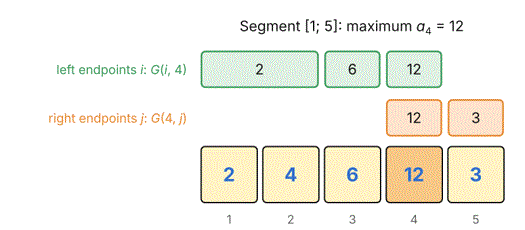
Left endpoints: G(4, 4) = 12, G(3, 4) = \gcd(6, 12) = 6, G(2, 4) = G(1, 4) = 2. We get the groups , and .
Right endpoints: G(4, 4) = 12, G(4, 5) = \gcd(12, 3) = 3. We get the groups and .
Let us go through all pairs of groups:
left group | right group | GCD | segments | contribution |
(12, 1) | (12, 1) | 12 | 1 | 12 |
(12, 1) | (3, 1) | 3 | 1 | 3 |
(6, 1) | (12, 1) | 6 | 1 | 6 |
(6, 1) | (3, 1) | 3 | 1 | 3 |
(2, 2) | (12, 1) | 2 | 2 | 4 |
(2, 2) | (3, 1) | 1 | 2 | 2 |
The sum of GCDs over the segments containing position is 12 + 3 + 6 + 3 + 4 + 2 = 30, and the contribution of these segments is 12 \cdot 30 = 360. For example, the last row of the table corresponds to the segments and : for each of them the GCD is 1 and the maximum is 12.
Then the segments and are processed recursively. All calls are listed in the table:
segment | \boldsymbol{a_m} | left groups | right groups | GCD sum | contribution | |
\boldsymbol{[1; 5]} | 4 | 12 | (12, 1), (6, 1), (2, 2) | (12, 1), (3, 1) | 30 | 360 |
\boldsymbol{[1; 3]} | 3 | 6 | (6, 1), (2, 2) | (6, 1) | 10 | 60 |
\boldsymbol{[1; 2]} | 2 | 4 | (4, 1), (2, 1) | (4, 1) | 6 | 24 |
\boldsymbol{[1; 1]} | 1 | 2 | (2, 1) | (2, 1) | 2 | 4 |
\boldsymbol{[5; 5]} | 5 | 3 | (3, 1) | (3, 1) | 3 | 9 |
The answer is 360 + 60 + 24 + 4 + 9 = 457.
Algorithm Implementation
Declare the constants:
\mathit{MOD} = 10^9 + 7 — the modulus,
\mathit{LOG} = 18 — the largest exponent in the sparse tables (2^{18} > 2 \cdot 10^5).
Declare the type ll.
#define MOD 1000000007LL
#define LOG 18 // 2^18 = 262144 > 2*10^5
typedef long long ll;
The sequence is stored in the array ; elements are indexed from zero. The value equals \lfloor \log_2 \mathit{len} \rfloor. The sparse table \mathit{spMax}[i][k] stores the index of the maximum element, and \mathit{spGcd}[i][k] stores the GCD of the elements on the segment [i; i + 2^k - 1].
vector<int> a;
vector<int> lg2;          // lg2[len] = floor(log2(len))
// spMax[i][k] — index of the maximum on [i, i + 2^k)
vector<vector<int>> spMax;
// spGcd[i][k] — GCD on [i, i + 2^k)
vector<vector<int>> spGcd;
The function gcd computes the GCD of two numbers using the Euclidean algorithm.
int gcd(int x, int y)
{
  while (y) { int t = x % y; x = y; y = t; }
  return x;
}
The function better, given two indices and , returns the one whose array element is larger. If the elements are equal, it returns .
int better(int i, int j)
{
  return a[i] >= a[j] ? i : j;
}
The function build fills the array and builds both sparse tables in O(n \log n \cdot \log C), C \le 10^9.
void build()
{
  lg2.assign(n + 1, 0);
  for (int len = 2; len <= n; len++) lg2[len] = lg2[len / 2] + 1;
  spMax.assign(n, vector<int>(LOG + 1));
  spGcd.assign(n, vector<int>(LOG + 1));
  for (int i = 0; i < n; i++)
  {
    spMax[i][0] = i;
    spGcd[i][0] = a[i];
  }
  for (int k = 1; (1 << k) <= n; k++)
    for (int i = 0; i + (1 << k) <= n; i++)
    {
      int h = 1 << (k - 1);    // half of the block length
      spMax[i][k] = better(spMax[i][k - 1], spMax[i + h][k - 1]);
      spGcd[i][k] = gcd(spGcd[i][k - 1], spGcd[i + h][k - 1]);
    }
}The function qMax returns the index of the maximum element on the segment [l; r].
int qMax(int l, int r)
{
  int k = lg2[r - l + 1];
  return better(spMax[l][k], spMax[r - (1 << k) + 1][k]);
}
The function qGcd returns the GCD of the elements on the segment [l; r]. Blocks of length 2^k may overlap, but this does not affect the result, since \gcd(x, x) = x.
int qGcd(int l, int r)
{
  int k = lg2[r - l + 1];
  return gcd(spGcd[l][k], spGcd[r - (1 << k) + 1][k]);
}
The function lastRight finds the rightmost position t \in [\mathit{from}; e] such that G(m, t) = g. Here g = G(m, \mathit{from}). Since does not increase as grows, the equality holds on some initial part of the segment , and binary search finds its last position. The midpoint is computed as (\mathit{lo} + \mathit{hi} + 1) / 2 so that the search does not get stuck on the assignment \mathit{lo} = \mathit{mid}.
int lastRight(int m, int from, int e, int g)
{
  int lo = from, hi = e;
  while (lo < hi)
  {
    int mid = (lo + hi + 1) / 2;
    if (qGcd(m, mid) == g) lo = mid; else hi = mid - 1;
  }
  return lo;
}The function firstLeft symmetrically finds the leftmost position t \in [b; \mathit{from}] such that G(t, m) = g.
int firstLeft(int m, int from, int b, int g)
{
  int lo = b, hi = from;
  while (lo < hi)
  {
    int mid = (lo + hi) / 2;
    if (qGcd(mid, m) == g) hi = mid; else lo = mid + 1;
  }
  return lo;
}The structure Group describes a group of segment endpoints:
— the GCD value,
— the number of positions in the group.
struct Group { int g; ll cnt; };The function solve returns, modulo , the sum of P(i, j) over all segments lying inside . For an empty segment the sum is .
ll solve(int b, int e)
{
  if (b > e) return 0;
Find the position of the maximum element on .
int m = qMax(b, e);Split the right endpoints j = m, m + 1, \ldots, e into groups. For the current compute g = G(m, j) and use the function lastRight to find the last position of the group. The group contains t - j + 1 positions; the next group starts at position t + 1.
  vector<Group> R;
  for (int j = m; j <= e; )
  {
    int g = qGcd(m, j);
    int t = lastRight(m, j, e, g);
    R.push_back({ g, t - j + 1 });
    j = t + 1;
}Similarly, split the left endpoints i = m, m - 1, \ldots, b into groups. The group occupies positions from to and contains i - t + 1 positions; the next group ends at position t - 1.
  vector<Group> L;
  for (int i = m; i >= b; )
  {
    int g = qGcd(i, m);
    int t = firstLeft(m, i, b, g);
    L.push_back({ g, i - t + 1 });
    i = t - 1;
}Compute the sum of GCD values over all segments containing position . For each pair of groups add \gcd(l.g, r.g) \cdot l.\mathit{cnt} \cdot r.\mathit{cnt}. The product l.\mathit{cnt} \cdot r.\mathit{cnt} does not exceed 4 \cdot 10^{10} and fits into the type long long. We reduce it modulo ; after that, the product of the GCD (less than 2^{30}) and a number less than also fits into long long.
  ll sumG = 0;
  for (Group &l : L)
    for (Group &r : R)
    {
      ll cnt = (l.cnt * r.cnt) % MOD;
      sumG = (sumG + gcd(l.g, r.g) % MOD * cnt) % MOD;
}The maximum on all segments containing equals a_m, so their total contribution equals a_m \cdot \mathit{sumG}.
ll res = (ll)a[m] % MOD * sumG % MOD;Add the recursively computed sums for the segments lying entirely to the left and to the right of position .
  return (res + solve(b, m - 1) + solve(m + 1, e)) % MOD;
}
The main part of the program. Read the input data.
scanf("%d", &n);
a.resize(n);
for (int &x : a) scanf("%d", &x);
Build the sparse tables.
build();Print the answer for the whole array — the segment [0; n - 1].
printf("%lld\n", solve(0, n - 1));