Get a tree#978

Perform a depth-first search starting from the first vertex. Build the depth-first search tree and print all of its edges.
Example
The graph given in the example has the following structure:
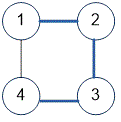
When the depth-first search is started from vertex , the traversal will go through the edges: (1, 2), (2, 3), (3, 4).
Algorithm implementation
The adjacency matrix of the graph is stored in the array .
#define MAX 101
int g[MAX][MAX], used[MAX];
The dfs function performs a depth-first search starting from vertex . Each edge that is part of the depth-first search tree is printed.
void dfs(int v)
{
  used[v] = 1;
  for (int i = 1; i <= n; i++)
    if (g[v][i] && !used[i])
    {
      printf("%d %d\n",v,i);
      dfs(i);
    }
}The main part of the program. Read the input data.
scanf("%d %d",&n,&m);
memset(g,0,sizeof(g)); memset(used,0,sizeof(used));
while(m--)
{
  scanf("%d %d",&a,&b);
  g[a][b] = g[b][a] = 1;
}Start a depth-first search from the first vertex.
dfs(1);Java implementation
import java.util.*;

public class Main
{
  static int g[][], used[];
  static int n, m;

  static void dfs(int v)
  {
    used[v] = 1;
    for(int i = 1; i <= n; i++)
      if (g[v][i] == 1 && used[i] == 0)
      {
        System.out.println(v + " " + i);
        dfs(i);
      }
    used[v] = 2;
  }

  public static void main(String[] args)
  {
    Scanner con = new Scanner(System.in);
    n = con.nextInt();
    m = con.nextInt();
    g = new int[n+1][n+1];
    used = new int[n+1];

    for(int i = 0; i < m; i++)
    {
      int a = con.nextInt();
      int b = con.nextInt();
      g[a][b] = g[b][a] = 1;
    }

    dfs(1);
    con.close();
  }
}