Connectivity#982

Using depth-first search, we can calculate the number of connected components. If it equals , the graph is connected.
Another solution is to start a depth-first search from vertex and count the number of visited vertices. If it equals , the graph is connected.
Example
Graphs given in example, have the form:
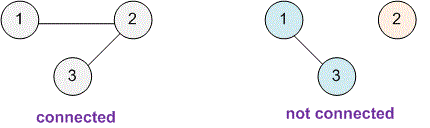
Algorithm implementation
Declare the adjacency matrix and the array of visited vertices .
#define MAX 101
int g[MAX][MAX], used[MAX];
The dfs function performs a depth-first search starting from vertex .
void dfs(int v)
{
  used[v] = 1;
  for (int i = 1; i <= n; i++)
    if (g[v][i] && !used[i]) dfs(i);
}
The main part of the program. Read the input data.
scanf("%d %d", &n, &m);Initialize the arrays.
memset(g,0,sizeof(g));
memset(used,0,sizeof(used));
Сonstruct the adjacency matrix of the graph.
for (i = 0; i < m; i++)
{
  scanf("%d %d", &a, &b);
  g[a][b] = g[b][a] = 1;
}
The number of connected components is stored in the variable .
cnt = 0;Start a depth-first search on a disconnected graph.
for (i = 1; i <= n; i++)
  if (!used[i])
  {
The number of dfs function calls equals the number of connected components in the graph.
    dfs(i);
    cnt++;
  }
Print the result. If the graph has only one connected component, it is connected.
if (cnt == 1) printf("YES\n");
else printf("NO\n");
Algorithm implementation — the number of visited vertices
Declare the adjacency matrix and the array of visited vertices .
#define MAX 101
int g[MAX][MAX], used[MAX];
The dfs function performs a depth-first search starting from vertex . The variable keeps track of the number of visited vertices.
void dfs(int v)
{
  used[v] = 1;
  cnt++;
  for (int i = 1; i <= n; i++)
    if ((g[v][i] == 1) && (used[i] == 0)) dfs(i);
}The main part of the program. Read the input data.
scanf("%d %d", &n,&m);Initialize the arrays.
memset(g, 0, sizeof(g));
memset(used, 0, sizeof(used));
Сonstruct the adjacency matrix of the graph.
for (i = 0; i < m; i++)
{
  scanf("%d %d", &a, &b);
  g[a][b] = g[b][a] = 1;
}
Start a depth-first search from vertex .
cnt = 0;
dfs(1);
If the depth-first search visits all vertices, then the graph is connected.
if (cnt == n) printf("YES\n");
else printf("NO\n");
Algorithm implementation — disjoint sets union
Declare an array.
#define MAX 102
int mas[MAX];
The Repr function returns the representative of the set that contains vertex . We move along the pointer to the next element until we encounter the representative of the set (whose pointer points to itself).
int Repr(int n)
{
  while (n != mas[n]) n = mas[n];
  return n;
}
The Union function merges two sets containing vertices and . Find the representatives of the sets containing and . Let these representatives be x_1 and y_1. If x_1 = y_1, then and are already in the same set, and no further action is needed. Otherwise, we redirect the pointer of representative x_1 to y_1.
void Union(int x, int y)
{
  int x1 = Repr(x), y1 = Repr(y);
  if (x1 == y1) return;
  mas[x1] = y1;
}
The main part of the program. Read the input data.
scanf("%d %d", &n, &m);Initially, each vertex points to itself (mas[i] = i).
for (i = 1; i <= n; i++) mas[i] = i;Read the edges of the graph. For each edge , perform the union of the sets containing vertices and .
for (i = 1; i <= m; i++)
{
  scanf("%d %d", &a, &b);
  Union(a, b);
}
Count the number of connected components in the variable . This number equals the number of vertices that are representatives of their own sets (i.e., the vertices whose pointers point to themselves).
count = 0;
for (i = 1; i <= n; i++)
  if (mas[i] == i) count++;
Based on the value of the variable, print the result.
if (count == 1) printf("YES\n");
else printf("NO\n");
Python implementation
The dfs function performs a depth-first search starting from vertex .
def dfs(v):
  used[v] = 1
  for i in range(1, n + 1):
    if g[v][i] and not used[i]:
      dfs(i)
The main part of the program. Read the input data.
n, m = map(int, input().split())Initialize the lists.
g = [[0] * (n + 1) for _ in range(n + 1)]
used = [0] * (n + 1)
Сonstruct the adjacency matrix of the graph.
for i in range(m):
  a, b = map(int, input().split())
  g[a][b] = g[b][a] = 1
The number of connected components is stored in the variable .
cnt = 0Start a depth-first search on a disconnected graph.
for i in range(1, n + 1):
  if not used[i]:
The number of dfs function calls equals the number of connected components in the graph.
    dfs(i)
    cnt += 1
Print the result. If the graph has only one connected component, it is connected.
if cnt == 1:
  print("YES")
else:
  print("NO")
Python implementation — the number of visited vertices
The dfs function performs a depth-first search starting from vertex . The variable keeps track of the number of visited vertices.
def dfs(v):
  used[v] = 1
  global cnt
  cnt += 1
  for i in range(1, n + 1):
    if g[v][i] and not used[i]:
dfs(i)The main part of the program. Read the input data.
n, m = map(int, input().split())Initialize the lists.
g = [[0] * (n + 1) for _ in range(n + 1)]
used = [0] * (n + 1)
Сonstruct the adjacency matrix of the graph.
for i in range(m):
  a, b = map(int, input().split())
  g[a][b] = g[b][a] = 1
Start a depth-first search from vertex .
cnt = 0
dfs(1)
If the depth-first search visits all vertices, then the graph is connected.
if cnt == n:
  print("YES")
else:
  print("NO")
Python implementation — disjoint sets union
The Repr function returns the representative of the set that contains vertex . We move along the pointer to the next element until we encounter the representative of the set (whose pointer points to itself).
def Repr(n):
  while n != mas[n]:
    n = mas[n]
  return n
The Union function merges two sets containing vertices and . Find the representatives of the sets containing and . Let these representatives be x_1 and y_1. If x_1 = y_1, then and are already in the same set, and no further action is needed. Otherwise, we redirect the pointer of representative x_1 to y_1.
def Union(x, y):
  x1 = Repr(x)
  y1 = Repr(y)
  if x1 == y1: return
  mas[x1] = y1
The main part of the program. Read the input data.
n, m = map(int, input().split())Initially, each vertex points to itself (mas[i] = i).
mas = [0] * (n + 1)
for i in range(1, n + 1):
  mas[i] = i
Read the edges of the graph. For each edge , perform the union of the sets containing vertices and .
for _ in range(m):
  a, b = map(int, input().split())
  Union(a, b)
Count the number of connected components in the variable . This number equals the number of vertices that are representatives of their own sets (i.e., the vertices whose pointers point to themselves).
count = 0
for i in range(1, n + 1):
  if mas[i] == i:
    count += 1
Based on the value of the variable, print the result.
if count == 1:
  print("YES")
else:
  print("NO")