Recursive function 1#10296

Due to the limitation of n \le 10^{18}, it is impossible to use a linear array to store the results of the function . Therefore, we'll use a map data structure.
Example
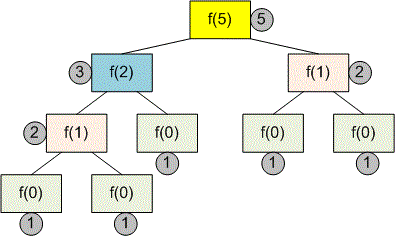
Consider the process of computing the function for n = 5:
Algorithm realization
Declare a map to store the function values: m[n] = f(n).
map<long long, long long> m;Implement the function f.
long long f(long long n)
{
  if (n == 0) return 1;
  if (m.count(n) > 0) return m[n];
  return m[n] = f(n / 2) + f(n / 3);
}
The main part of the program. Read the input value of . Compute and print the value of the function .
scanf("%lld", &n);
res = f(n);
printf("%lld\n", res);
Java realization
import java.util.*;

public class Main
{
  static Map<Long, Long> m = new HashMap<Long, Long>();
  static long n;

  public static long f(long n)
  {
    if (n == 0) return 1;
    if (m.containsKey(n)) return m.get(n);
    long res = f(n/2) + f(n/3);
    m.put(n,res);
    return res;
  }

  public static void main(String[] args)
  {
    Scanner con = new Scanner(System.in);
    n = con.nextLong();
    System.out.println(f(n));
    con.close();
  }
}Python realization
Declare a vocabulary to store the function values: m[n] = f(n).
m = {}Implement the function f.
def f(n):
  if n == 0:
    return 1
  if n in m:
    return m[n]
  m[n] = f(n // 2) + f(n // 3)
return m[n]The main part of the program. Read the input value of . Compute and print the value of the function .
n = int(input())
res = f(n)
print(res)