
Map
A map is a set of keys where each key carries a value with it, such as a number and how many times it occurred. The keys are kept sorted and found in O(\log n), exactly as in a set; the set page shows how.
In C++
A map<K, V>, in the header <map>, has keys of type K and values of type V. m[key] gives the value of a key. If the key is missing, m[key] first adds it with the value 0 (or an empty string). So cnt[x]++ counts: the first time a number comes, it appears with 0 and becomes 1.
This program reads n, then n numbers, and prints each number with its count:
6
5 2 8 5 2 5
#include <iostream>
#include <map>
using namespace std;
int main() {
int n;
cin >> n;
map<int, int> cnt;
for (int i = 0; i < n; i++) {
int x;
cin >> x;
cnt[x]++; // a new number starts at 0
}
for (auto& [x, c] : cnt) // keys in increasing order
cout << x << ' ' << c << '\n';
}Each key and its value form a pair: .first is the key and .second the value, and auto& [x, c] names the two. count, find, erase and lower_bound work on the keys, as in a set.

The map cnt is empty.
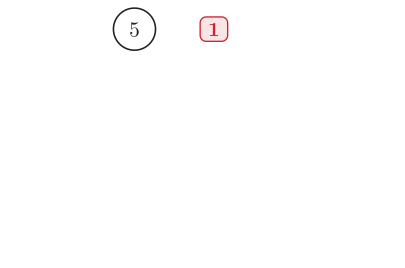
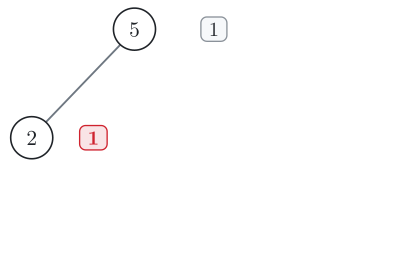
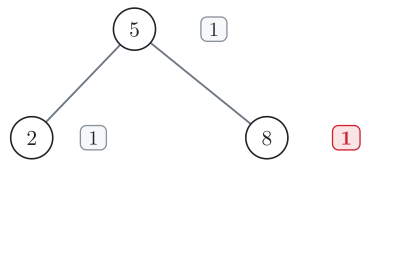
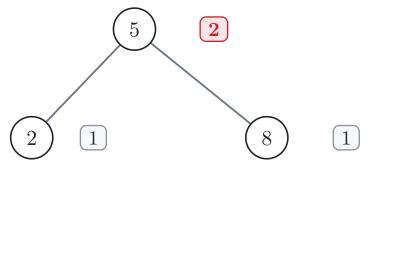
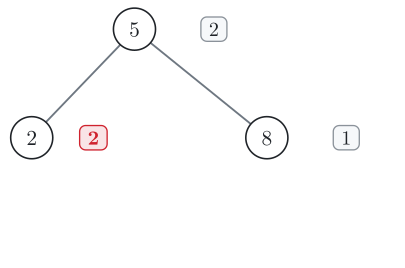
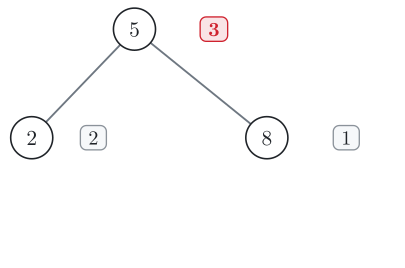
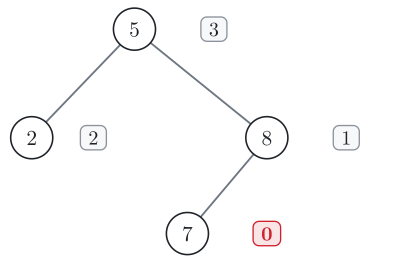
Fig. 1. The keys sit in a binary search tree, as in a set, and each key carries its count beside it. cnt[key] adds a missing key with 0, even when the code only reads it.
unordered_map
unordered_map has the same calls except lower_bound and upper_bound, and keeps no order. It is a hash table: each call takes on average, but tests can be built so that many keys land in the same bucket, and then every call takes . Use map by default.
Examples of use
Counting how many times each value occurs: cnt[x]++ for every value, then one loop over the map reads the counts in key order.
Giving numbers to names: when the vertices of a graph come as names, id[name] gives each new name the next free number, and the rest of the program works with numbers.
Similar structures
A set keeps the keys alone, with no value.
An array indexed by the key does the same in when the keys are non-negative integers up to about 10^6.
Practice
Very easy · Implementation
Very easy · Sorting