Maximum Frequency Stack#10379

For each number , we'll keep track of how many times it appears in the stack using freq[x]. We'll use a map as the data structure to store .
Declare an array of stacks vector<stack<int>> st, where contains the elements that appear in the stack exactly i + 1 times (note that the array is zero-indexed). The order of elements in reflects the order in which they were added to the stack.
Let the number be added to the stack for the -th time. If the stack st[k - 1] has not been created yet, add it using push_back. Then, place on top of the stack st[k - 1].
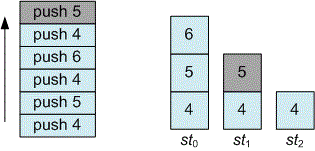
When removing an element, it is necessary to extract the top element from the last non-empty stack.
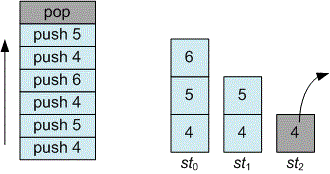
For example, if only pop operations are performed from this point on, the elements will be removed from the stack in the following order: 4, 5, 4, 6, 5, 4.
Example
Let us examine the order in which elements are added to the array of stacks in the following example.
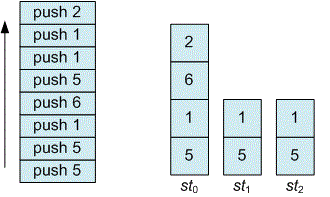
When performing pop operations, the elements will be extracted in the following order: 1, 5, 1, 5, 2, 6, 1, 5.
Algorithm implementation
To work with the frequency stack, we define a class called FreqStack.
class FreqStack
{
public:
Let's declare:
a map , where freq[x] stores the number of times element appears in the stack;
an array of stacks ;
  map<int, int> freq;
  vector<stack<int>> st;
The push function adds element to the stack.
  void push(int x)
  {
    int f = freq[x];
    freq[x] = f + 1;
    if (f == st.size()) st.push_back(stack<int>());
    st[f].push(x);
}The pop function removes an element from the stack.
  int pop()
  {
    int x = st.back().top();
    st.back().pop();
    if (st.back().empty()) st.pop_back();
    freq[x]--;
    return x;
  }
};The main part of the program. Read the input data and simulate the behavior of the stack.
while (cin >> str)
{
  if (str == "push")
  {
    cin >> n;
    fs.push(n);
  }
  else // pop
    cout << fs.pop() << endl;
}