Sum of distances#10761

Let's use the disjoint-set data structure. Initially, each vertex will be placed in a separate set. We will iterate through the edges in decreasing order of their weights. For each edge , we will run the Union(u, v) function. It will merge the sets containing vertices and .
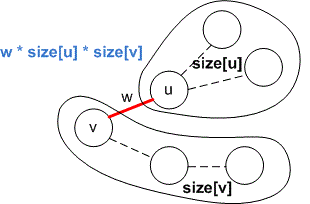
Consider the current edge of the tree with weight . Let it merge the sets with sizes size[u] and size[v]. All edges in these two sets have weights greater than or equal to . The edge is part of size[u] \cdot size[v] different paths. Since the weight is minimal, the distances of these paths are equal to . Therefore, the contribution of these paths to the sum of distances of all pairs of vertices is w \cdot size[u] \cdot size[v].
Example
Consider the first test.
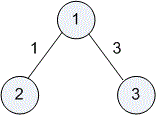
The graph contains three paths:
1 → 2 (distance );
1 → 3 (distance );
2 → 1 → 3 (distance );
The sum of distances between all pairs of vertices is equal to 1 + 3 + 1 = 5.
Consider the second test.
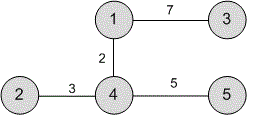
Assign each vertex to a separate set.
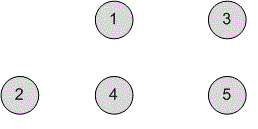
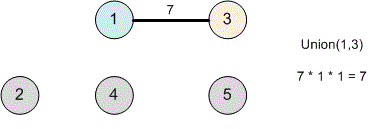
Iterate through the edges in descending order of weight. The first edge will be . Perform Union (1, 3). The distance has size[1] \cdot size[3] = 1 \cdot 1 = 1 path (from to ).
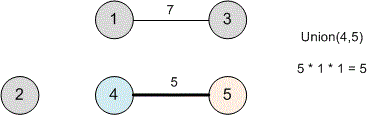
The next edge will be . Perform Union(4, 5). The distance has size[4] \cdot size[5] = 1 \cdot 1 = 1 path (from to ).
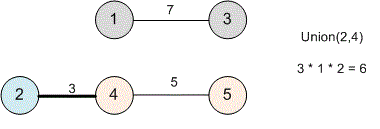
The next edge will be . Perform Union(2, 4). The distance have size[2] \cdot size[4] = 1 \cdot 2 = 2 paths (from to and from to ).
The next edge will be . Perform Union(1, 4). The distance have size[1] \cdot size[4] = 2 \cdot 3 = 6 paths (2 → 4 → 1, 4 → 1, 5 → 4 → 1, 2 → 4 → 1 → 3, 4 → 1 → 3, 5 → 4 → 1 → 3).
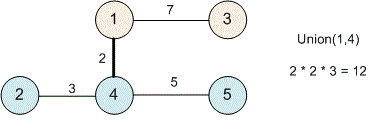
The desired sum of distances is equal to 7 + 5 + 6 + 12 = 30.
Algorithm implementation
Declare arrays used by the disjoint-set system.
struct Edge
{
  int u, v, cost;
} temp;
vector<Edge> e;
vector<int> parent, ssize;
The cmpGreater function is a comparator that sorts the edges in descending order of weight.
int cmpGreater(Edge a, Edge b)
{
  return a.cost > b.cost;
}
The Repr function returns the representative of the set containing the vertex .
int Repr(int v)
{
  if (v == parent[v]) return v;
  return parent[v] = Repr(parent[v]);
}
The Union function merges sets with elements and . Implement the heuristic with set sizes.
void Union(int x, int y)
{
  x = Repr(x); y = Repr(y);
  if (x == y) return;
  if (ssize[x] < ssize[y]) swap(x, y);
  parent[y] = x;
  ssize[x] += ssize[y];
}The main part of the program. Read the number of vertices in the graph.
scanf("%d", &n);Initialize the arrays.
parent.resize(n + 1);
ssize.resize(n + 1);
for (i = 0; i <= n; i++)
{
  parent[i] = i;
  ssize[i] = 1;
}Read the edges of the tree. Store them in the array .
for (i = 0; i < n - 1; i++)
{
  scanf("%d %d %d", &temp.u, &temp.v, &temp.cost);
  e.push_back(temp);
}
Sort the edges in descending order of weights.
sort(e.begin(), e.end(), cmpGreater);Compute the sum of distances between all pairs of vertices in the variable .
res = 0;Iterate through the edges. For each edge with weight call the Union(u, v) function. Add the contribution of all paths with distance to .
for (i = 0; i < e.size(); i++)
{
  res += 1LL * e[i].cost * ssize[Repr(e[i].u)] * ssize[Repr(e[i].v)];
  Union(e[i].u, e[i].v);
}
Print the answer.
printf("%lld\n", res);Python implementation
Declare a class , describing an edge of the graph.
class Edge:
  def __init__(self, u, v, cost):
    self.u = u
    self.v = v
    self.cost = cost
The cmpGreater function is a comparator that sorts the edges in descending order of weight.
def cmpGreater(a, b):
    return a.cost > b.cost
The Repr function returns the representative of the set containing the vertex .
def Repr(v):
  if v == parent[v]: return v
  parent[v] = Repr(parent[v])
  return parent[v]
The Union function merges sets with elements and . Implement the heuristic with set sizes.
def Union(x, y):
  x = Repr(x)
  y = Repr(y)
  if x == y: return
  if ssize[x] < ssize[y]:
    x, y = y, x
  parent[y] = x
ssize[x] += ssize[y]The main part of the program. Read the number of vertices in the graph.
n = int(input().strip())Initialize the lists.
parent = list(range(n + 1))
ssize = [1] * (n + 1)
e = []
Read the edges of the tree. Store them in the list .
for _ in range(n - 1):
  u, v, cost = map(int, input().split())
  e.append(Edge(u, v, cost))
Sort the edges in descending order of weights.
e.sort(key=lambda x: x.cost, reverse=True)Compute the sum of distances between all pairs of vertices in the variable .
res = 0Iterate through the edges. For each edge with weight call the Union(u, v) function. Add the contribution of all paths with distance to .
for edge in e:
  res += edge.cost * ssize[Repr(edge.u)] * ssize[Repr(edge.v)]
  Union(edge.u, edge.v)
Print the answer.
print(res)