Petrol Stations#1388

Let be the cost of gasoline in the -th city. For each pair of cities and , add a directed edge from to with weight , as well as a directed edge from to with weight .
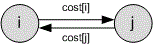
To solve the problem, find the minimum cost path from city to city .
Example
Let’s construct the graph given in the first example.
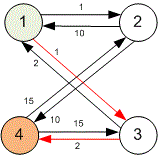
The minimum cost route from vertex to vertex is: 1 → 3 → 4. Its cost is 1 + 2 = 3.
Algorithm realization
Store the graph in an adjacency matrix . The current shortest distances from the starting vertex to the other vertices are stored in an array . The array holds the gasoline cost in each city.
#define MAX 110
#define INF 0x3F3F3F3F
int g[MAX][MAX], used[MAX], d[MAX], cost[MAX];
Read the number of cities and the gasoline cost in each of them.
scanf("%d",&n);
for(i = 1; i <= n; i++)
  scanf("%d",&cost[i]);
Construct a graph representing the costs of traveling between cities.
memset(g,0x3F,sizeof(g));
memset(used,0,sizeof(used));
scanf("%d",&m);
for(i = 1; i <= m; i++)
{
  scanf("%d %d",&a,&b);
  g[a][b] = cost[a];
  g[b][a] = cost[b];
}Initialize the shortest distances from the first vertex to the other vertices.
memset(d,0x3F,sizeof(d));
d[1] = 0;
Start the loop of Dijkstra's algorithm. In each iteration find the vertex with the minimum distance from the starting vertex.
for(i = 1; i < n; i++)
{
  mind = INF; w = -1;
  for(j = 1; j <= n; j++)
    if (!used[j] && d[j] < mind) {mind = d[j]; w = j;}
If it turns out that w = -1, then the desired path does not exist, and we exit the loop.
if (w < 0) break;Relax all edges originating from vertex .
  for (j = 1; j <= n; j++)
    if (!used[j]) d[j] = min(d[j], d[w] + g[w][j]);
The shortest distance to vertex is computed.
  used[w] = 1;
}
Print the answer based on the value of . If it is infinity, then there is no path to vertex . Otherwise, print the shortest distance found.
if (d[n] == INF) printf("-1\n");
else printf("%d\n",d[n]);
Java realization
import java.util.*;

public class Main
{
  static final int INFINITY = 2000000000;
  static int g[][], used[], dist[], cost[];

  static void Relax(int i, int j)
  {
    if (dist[i] + g[i][j] < dist[j])
      dist[j] = dist[i] + g[i][j];
  }

  public static void main(String[] args)
  {
    Scanner con = new Scanner(System.in);
    int n = con.nextInt();
    g = new int[n+1][n+1];
    for (int[] row: g) Arrays.fill(row, INFINITY);

    cost = new int[n+1];
    for (int i = 1; i <= n; i++)
      cost[i] = con.nextInt();

    used = new int[n+1]; Arrays.fill(used, 0);
    dist = new int[n+1]; Arrays.fill(dist, INFINITY);
    dist[1] = 0;

    int m = con.nextInt();
    for (int i = 1; i <= m; i++)
    {
      int a = con.nextInt();
      int b = con.nextInt();
      g[a][b] = cost[a];
      g[b][a] = cost[b];

    }

    for (int i = 1; i < n; i++)
    {
      // find vertex w with minimum d[w] among not used vertices
      int min = INFINITY, v = -1;
      for (int j = 1; j <= n; j++)
        if (used[j] == 0 && dist[j] < min) { min = dist[j]; v = j; }

      // no more vertices to add
      if (v < 0) break;

      // relax all edges outgoing from v
      // process edge v -> j
      for (int j = 1; j <= n; j++)
        if (used[j] == 0 && g[v][j] != -1) Relax(v, j);

      // shortest distance to v is found
      used[v] = 1;
    }

    if (dist[n] == INFINITY) System.out.println(-1);
    else System.out.println(dist[n]);

    con.close();
  }
}