Distance in Tree#4104

A connected graph that contains no cycles is called a tree.
The distance between two vertices of a tree is defined as the length (in edges) of the shortest path connecting them.
Given a tree with vertices and a positive integer , calculate the number of distinct pairs of vertices in the tree whose distance is exactly . Note that the pairs and are considered the same.
The first line contains two integers and k~(1 \le n \le 50000, 1 \le k \le 500) — the number of vertices in the tree and the required distance between vertices.
Each of the following n - 1 lines describes an edge of the tree in the format a_i~b_i~(1 \le a_i, b_i \le n, a_i \ne b_i), where a_i and b_i are the vertices connected by the -th edge. All edges are distinct.
Print one integer — the number of distinct pairs of vertices in the tree whose distance is exactly .
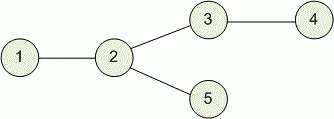
Example 1