Distance in Tree#4104

Let dp[v][x] denote the number of vertices at distance from vertex in the subtree rooted at . Set dp[v][0] = 1, since the only vertex at distance from is itself.
Suppose that vertex has children u_1, u_2, ..., u_p. Then the number of vertices at distance from vertex in the subtree rooted at is equal to the sum of the numbers of vertices at distance x - 1 from each of the vertices u_1, u_2, ..., u_p.
Consider the subtree rooted at vertex . Let's count the number of paths of length that lie entirely within this subtree and pass through vertex . We divide such paths into two groups:
paths that start at vertex . Their number is equal to dp[v][k].
paths that pass through vertex and whose endpoints are located in the subtrees of the children of vertex .
Consider a path of length that passes through the root of the subtree . Let the distance from vertex to one end of the path be x~(1 \le x \le k - 1). Suppose this end lies in the subtree of some child u_1. Then the distance from to the other end of the path is k - x, and this other end can be located in any other subtree except the subtree rooted at u_1.
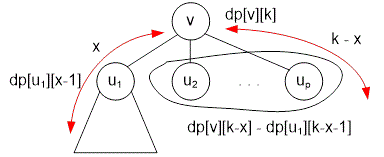
If the distance from the first end of the path to vertex is , then the distance from this end to vertex u_1 is x - 1. The number of ways to choose such a first end is dp[u_1][x - 1].
The number of ways to choose the second end of the path is equal to the number of vertices at distance k - x from vertex that do not belong to the subtree rooted at u_1. This number is
According to the multiplication principle, the total number of such paths is
Thus, the total number of such paths is
It remains to sum the above expression over all vertices of the tree.
Example
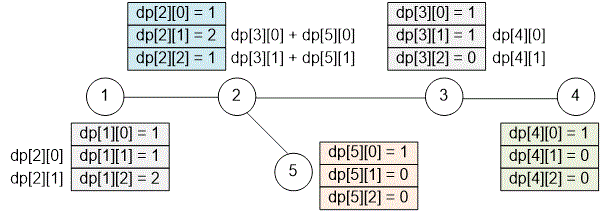
Consider the tree presented in the example.
Algorithm implementation
The array stores the tree representation in the form of adjacency lists. The array is used to implement dynamic programming.
vector<vector<int> > g;
vector<vector<int> > dp;
The function dfs performs a depth-first search starting from vertex . The value denotes the parent of vertex . During the traversal, the array is constructed.
void dfs(int v, int p = -1)
{
Initialize the array .
  dp[v].resize(k+1);
  dp[v][0] = 1;
Iterate over all vertices that can be reached from vertex .
  for (int to : g[v])
  {
    if (to == p) continue;

    dfs(to,v);

    for(int x = 1; x <= k; x++)
      dp[v][x] += dp[to][x-1];
  }
}The function dfsRes performs a depth-first search starting from vertex and is intended to compute the desired answer.
void dfsRes(int v, int p = -1)
{

  for (int to : g[v])
  {
    if (to == p) continue;

    dfsRes(to,v);

    for(int x = 1; x < k; x++)
      resA += 1LL * dp[to][x-1] * (dp[v][k-x] - dp[to][k-x-1]);
  }

  resB += dp[v][k];
}The main part of the program. Read the input data. Build the tree.
scanf("%d %d",&n,&k);
g.resize(n+1);

for (i = 0; i < n - 1; i++)
{
  scanf("%d %d",&a,&b);
  g[a].push_back(b);
  g[b].push_back(a);
}Using the first depth-first search, construct the array.
dp.resize(n+1);
dfs(1);
Compute and print the required answer.
resA = resB = 0;
dfsRes(1);
res = resA / 2 + resB;
printf("%lld\n",res);
Python implementation
The function dfs performs a depth-first search starting from vertex . The value denotes the parent of vertex . During the traversal, the array is constructed.
def dfs(v, p):Initialize the array .
  dp[v] = [0] * (k + 1)
  dp[v][0] = 1
Iterate over all vertices that can be reached from vertex .
  for to in g[v]:
    if to == p: continue
    dfs(to, v)

    for x in range(1, k + 1):
      dp[v][x] += dp[to][x - 1]
The function dfsRes performs a depth-first search starting from vertex and is intended to compute the desired answer.
def dfsRes(v, p):
  global resA, resB
  for to in g[v]:
    if to == p: continue
    dfsRes(to, v)

    for x in range(1, k):
      resA += dp[to][x - 1] * (dp[v][k - x] - dp[to][k - x - 1])

resB += dp[v][k]The main part of the program. Read the number of vertices of the tree, and the distance between vertices .
n, k = map(int, input().split())The list stores the tree representation using adjacency lists. The list is used to implement dynamic programming.
g = [[] for _ in range(n + 1)]
dp = [[] for _ in range(n + 1)]
Read the list of edges. Build the tree.
for _ in range(n - 1):
  a, b = map(int, input().split())
  g[a].append(b)
  g[b].append(a)
Using the first depth-first search, construct the array.
dfs(1, -1)Compute and print the required answer.
resA, resB = 0, 0
dfsRes(1, -1)
res = resA // 2 + resB
print(res)