
Difference arrays
A difference array applies many changes of the form "add x to every element from l to r" with two small writes each, and one running total at the end gives the final array. If the values must be read between the changes, use a Fenwick tree instead.
Explanation
An array has 5 elements, all 0, and 3 must be added to elements 2 to 4. In a second row, write +3 under element 2 and −3 under element 5, then take the running total of that row (each cell plus everything before it) from left to right: 0, 3, 3, 3, 0. The −3 is what stops the change: without it, the running total would carry the 3 on into element 5.
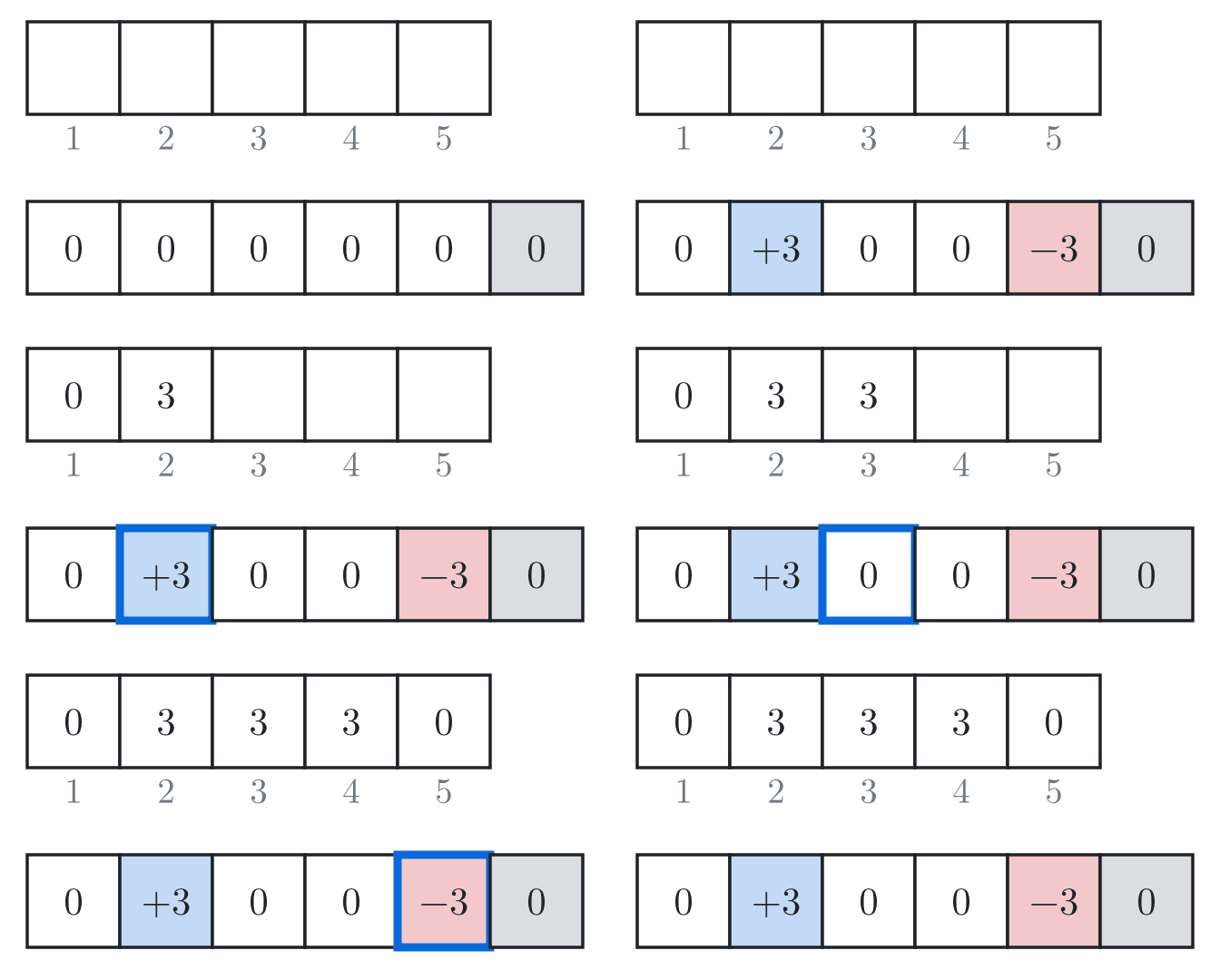
Fig. 1. +3 under element 2 and −3 under element 5 add 3 to elements 2 to 4.
Real problems have many changes, and they overlap. A bike shop rents out bikes for 8 days. There are four rentals: 3 bikes on days 2 to 5, 2 bikes on days 4 to 8, 1 bike on days 1 to 3, and 4 bikes on days 6 to 7. How many bikes are out on each day? Writing each rental into every day it covers takes 4 + 5 + 3 + 2 = 14 additions here. With 10^6 days and 10^6 rentals that can be 10^{12} additions, far too slow.
A running total carries each number forward to every later day, so each rental needs only two marks: its number on its first day, and minus its number on the first day it no longer covers. Rental 1 gets +3 on day 2 and −3 on day 6.
This row of marks is the difference array. Using it takes two steps: mark each change with +x at l and −x at r + 1, then build the final values with one running total.
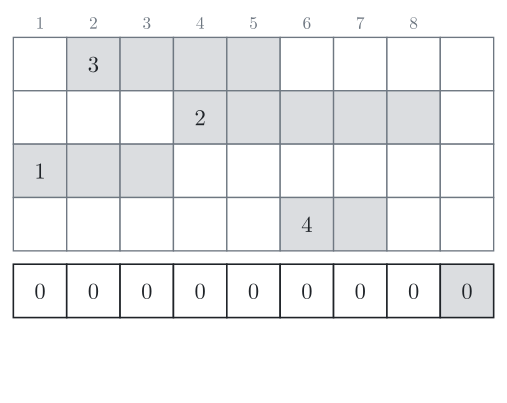
Before any rental is marked, every mark is 0.
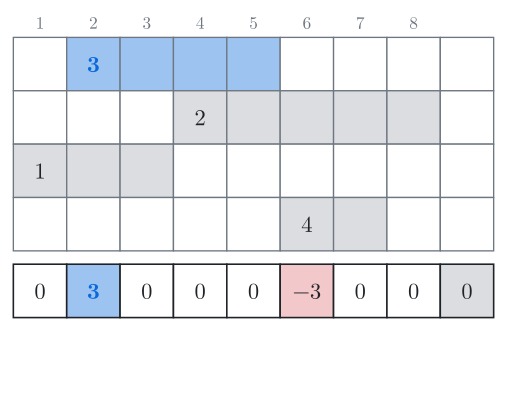
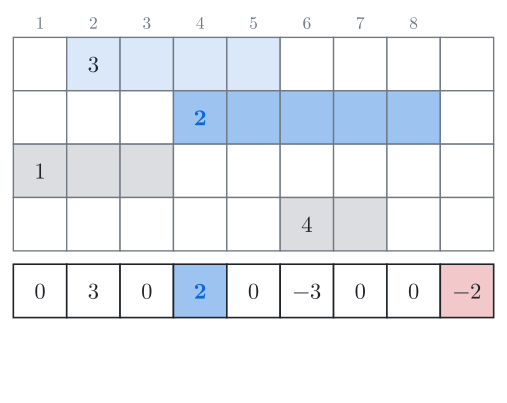
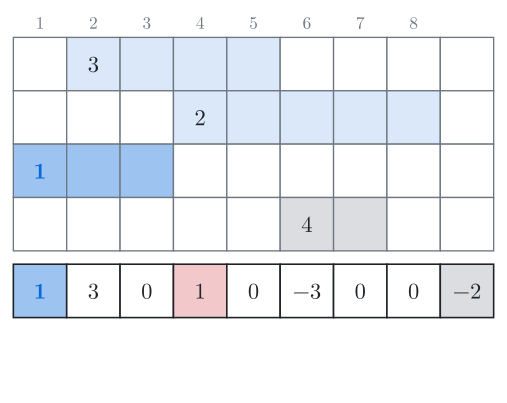
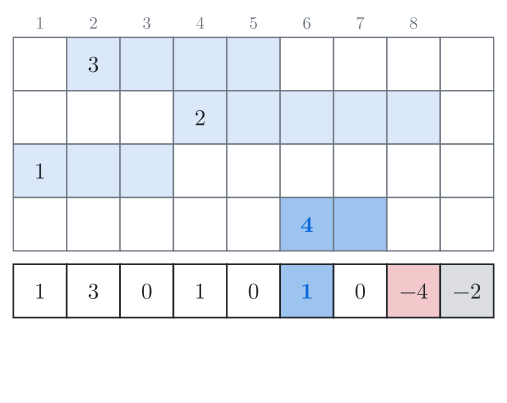
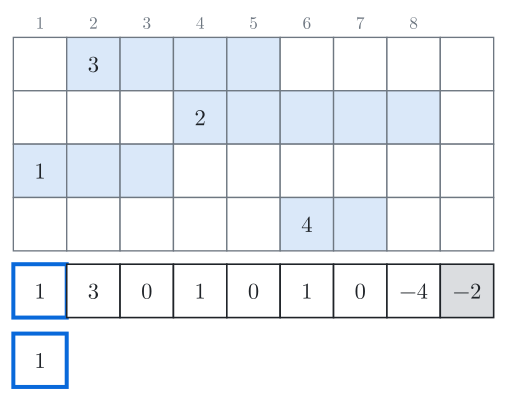
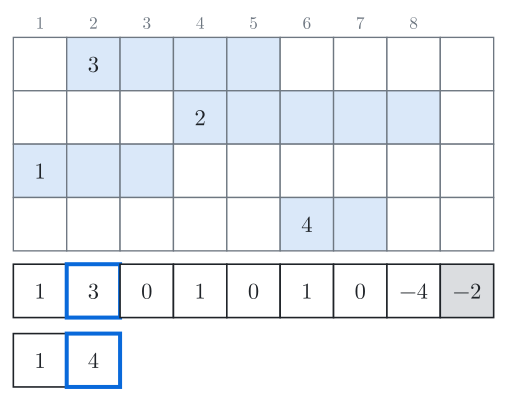
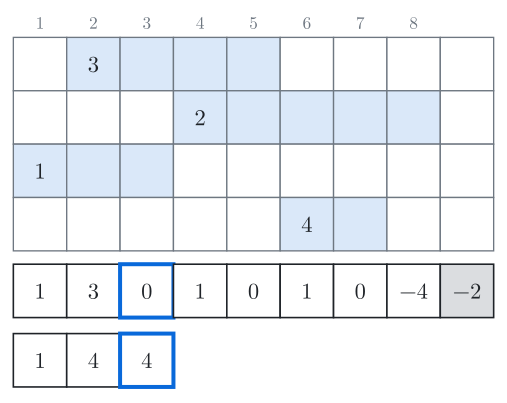
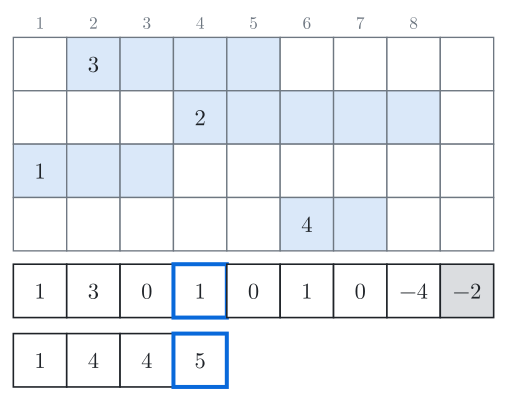
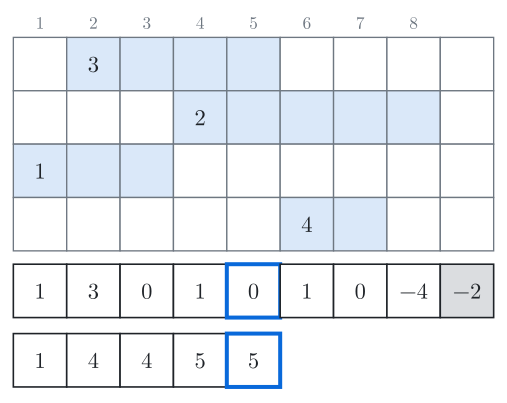
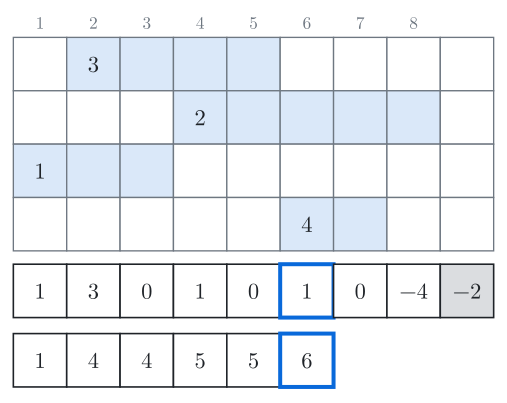
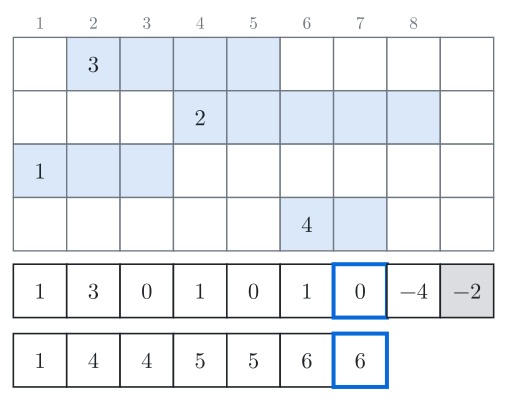
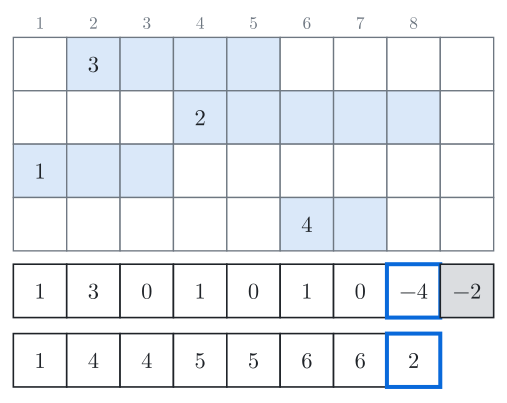
Fig. 2. Step through the marks and the running total with the buttons or the arrow keys. Blue +x marks add a rental, red −x marks take it away, and the outlined cells are the ones being added.
The build gave every day's count at once, 1, 4, 4, 5, 5, 6, 6, 2, with 8 marks and one pass over the days instead of 14 additions.
Each mark is a day's count minus the count of the day before: day 6 has 6 bikes, day 5 has 5, and the mark on day 6 is 1. So if the array doesn't start at zeros, first read it into marks, each one the element minus the element before it. The array 4, 4, 7, 7, 7, 2 gives marks 4, 0, 3, 0, 0, −5. Adding 1 to elements 2 to 3 makes them 4, 1, 3, −1, 0, −5, and the running total gives 4, 5, 8, 7, 7, 2.
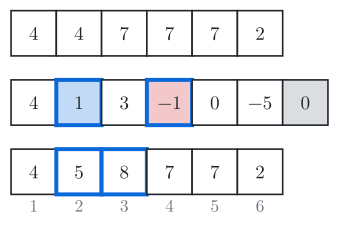
Fig. 3. The change touches only cells 2 and 4; every other mark keeps the difference it started with.
Reach for a difference array when a problem has many changes to ranges of consecutive elements, and the values are read only after all of them.
In C++
The elements are a[1] to a[n], with a[0] = 0. Rental 1 above becomes d[2] += 3 and d[6] -= 3.
vector<long long> d(n + 2, 0);   // n + 2 cells: the mark at r + 1 can land at n + 1;
                                 // with n + 1 cells it writes past the end

// read
for (int i = 1; i <= n; i++)
    d[i] = a[i] - a[i - 1];      // differences of the starting array (all 0 if it starts at zeros)

// mark: add x to elements l to r
d[l] += x;
d[r + 1] -= x;

// build
for (int i = 1; i <= n; i++)
a[i] = a[i - 1] + d[i];The range must have l ≤ r. If the input may give the ends in either order, swap them first: with l = 4, r = 2 the marks would subtract 1 from element 3.
Each change takes and the build takes , so k changes take O(n + k) time and memory.
Cover counts and the busiest point
When every change adds 1, or the size of a booking, the built values count what covers each element, and the largest one is the busiest element. On the rentals, the largest value is 6 bikes, on days 6 and 7. Keeping the maximum while building gives it.
// mark: each interval adds x (x = 1 to count intervals)
for (int j = 0; j < k; j++) {
    int l, r;
    long long x;
    cin >> l >> r >> x;
    d[l] += x;
    d[r + 1] -= x;
}

// build, keeping the largest value
long long best = 0;
for (int i = 1; i <= n; i++) {
    a[i] = a[i - 1] + d[i];
    best = max(best, a[i]);
}If an interval is given as [l, r), so that it doesn't cover r, the −x mark goes at r. If times start at 0, add 1 to every time. To count the elements covered at least c times, replace best = max(best, a[i]) with if (a[i] >= c) cnt++.
Common mistakes
Forgetting the −x mark keeps a change in the total forever. With only first-day marks on the rentals, the totals are 1, 4, 4, 6, 6, 10, 10, 10, so day 6 shows 10 instead of 6. Every change needs both marks.
Similar techniques
Prefix sums answer range-sum questions about an array that doesn't change.
2D prefix sums apply changes to rectangles of a table with four marks each.
When the questions ask for range sums or minimums between range changes, use a segment tree with lazy propagation. For questions about one element, the Fenwick tree from the question above is enough.
A sweep line uses the same marks when coordinates reach 10^9 and no array fits: it sorts the marks in O(k \log k) and walks them in order.
Practice
Very easy · Implementation · Prefix Sums
Very easy · Prefix Sums · Implementation
Very easy · Greedy algorithms · Prefix Sums
Very easy · Prefix Sums · Binary Search · Fenwick Tree